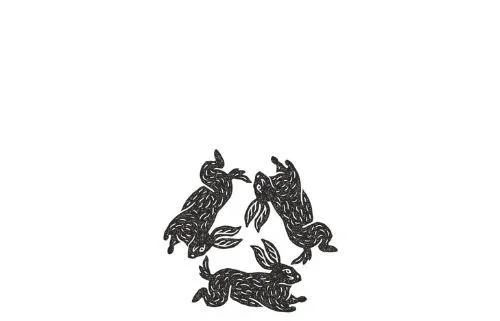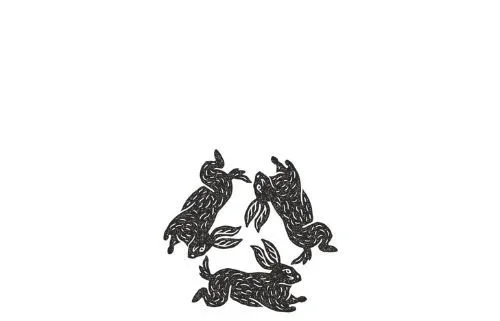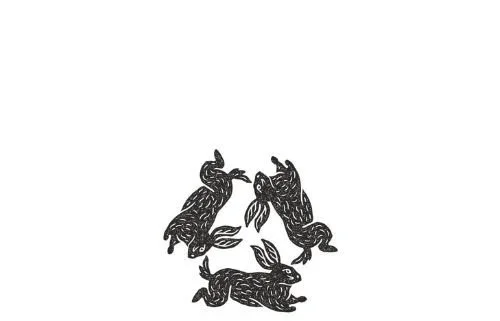
Three Hare Song
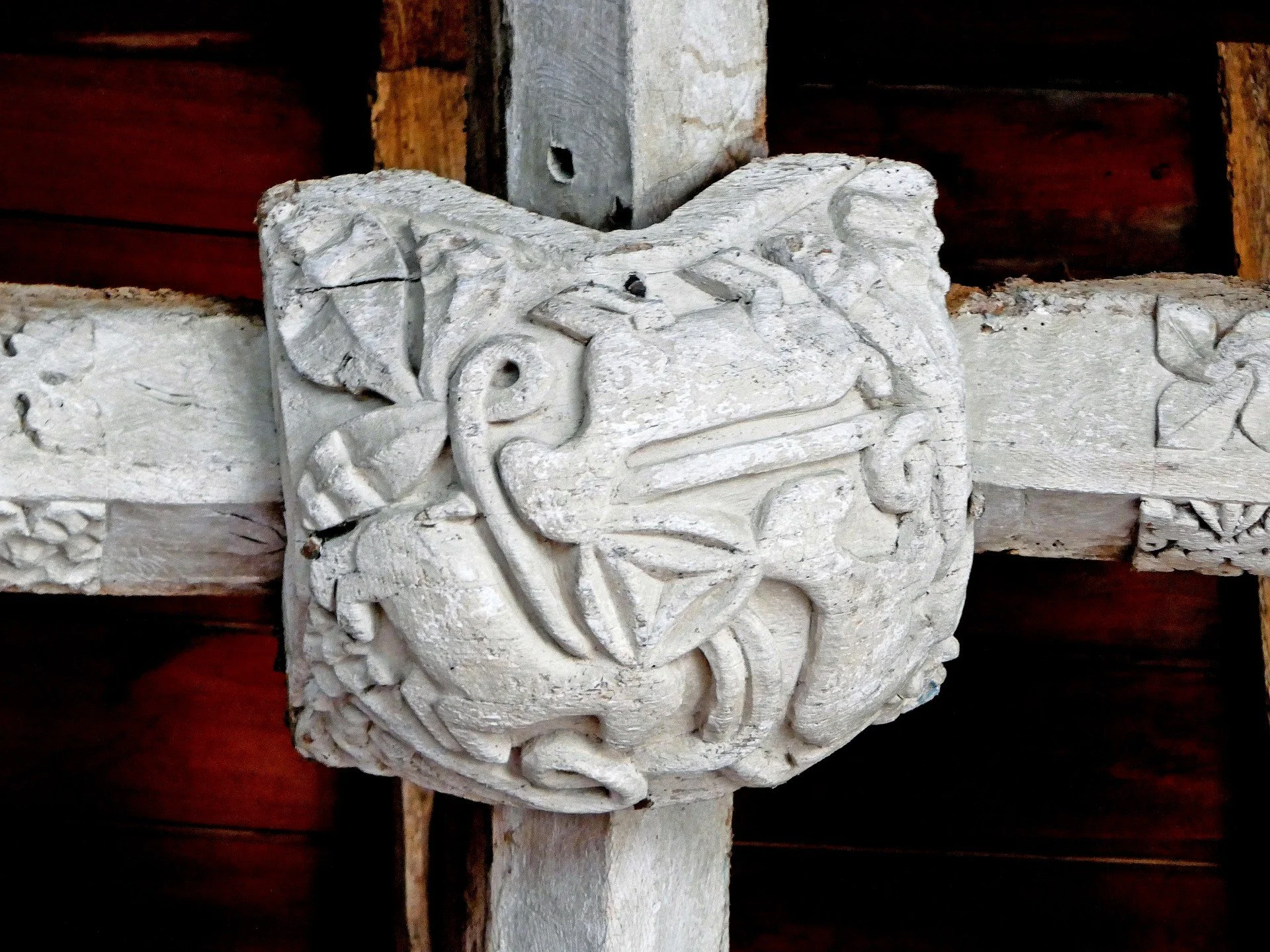
Image credit: Sue Andrew
This earth – this portion – it is
like a green kiss upon
the cheek of God; soft
rolling memories of breath
and limestone. Mark, carefully, the land
of peat and tin and moss and know
there are knockers fingering copper
in its darkest corners and piskies
curdling milk and pinching children and
across the moors heed the screams
of frothed mares bolting
from the last wild hunt.
There is a brilliance here
when the sun soaks
and slips like butter –
a prophet’s alchemy of fire
from the sky drooling
over bluffs and scarps –
to think, such simple chemistry
eluded us and the ancients both.
After all, we could never birth a gold
as brazen as the skies of Dumnonia –
yet despite the acid-grass and thunder
this land is tender – a hare’s heart
holds no chambers but is wide
and heathered and packed with
pity for these mortal frames
sprinting and gasping
from dust to dust. They smell
the impotence in men’s fingertips
and choose instead to grant us memory,
gilded thoughts from Devon’s golden
cerebrum – ideas, impressions –
inspiration from the blood
and the cud – listen closely
the gorse is singing.
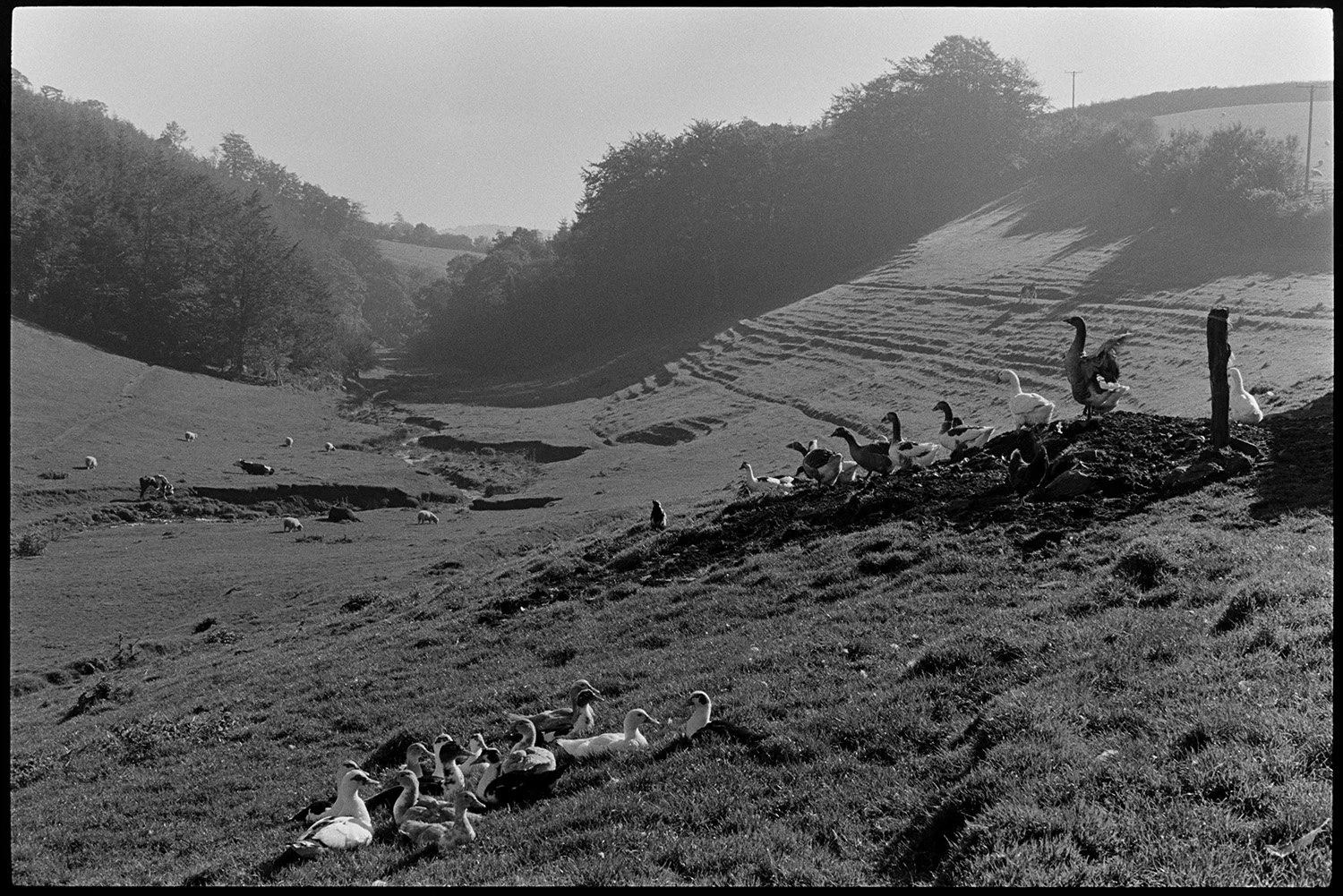
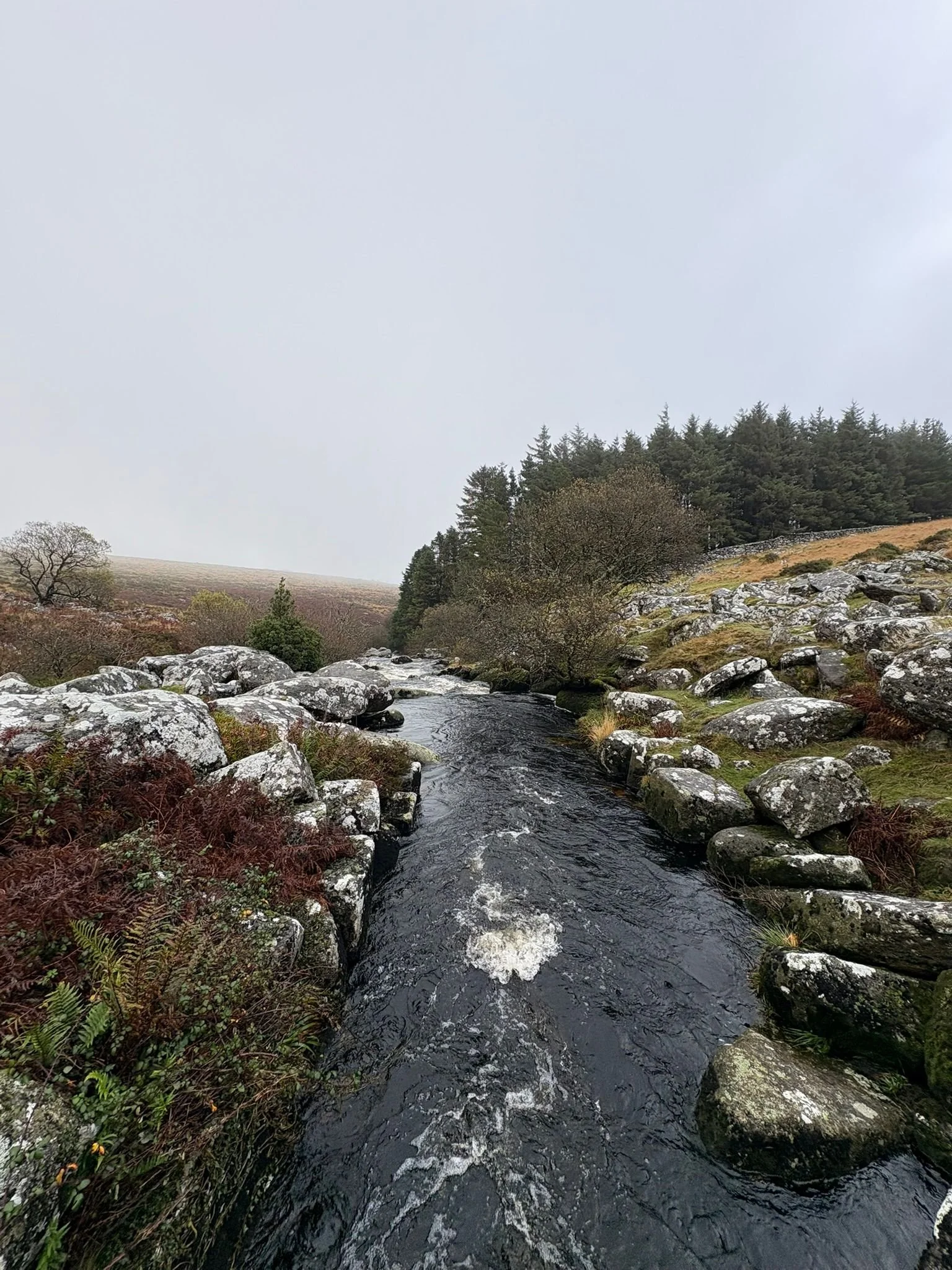
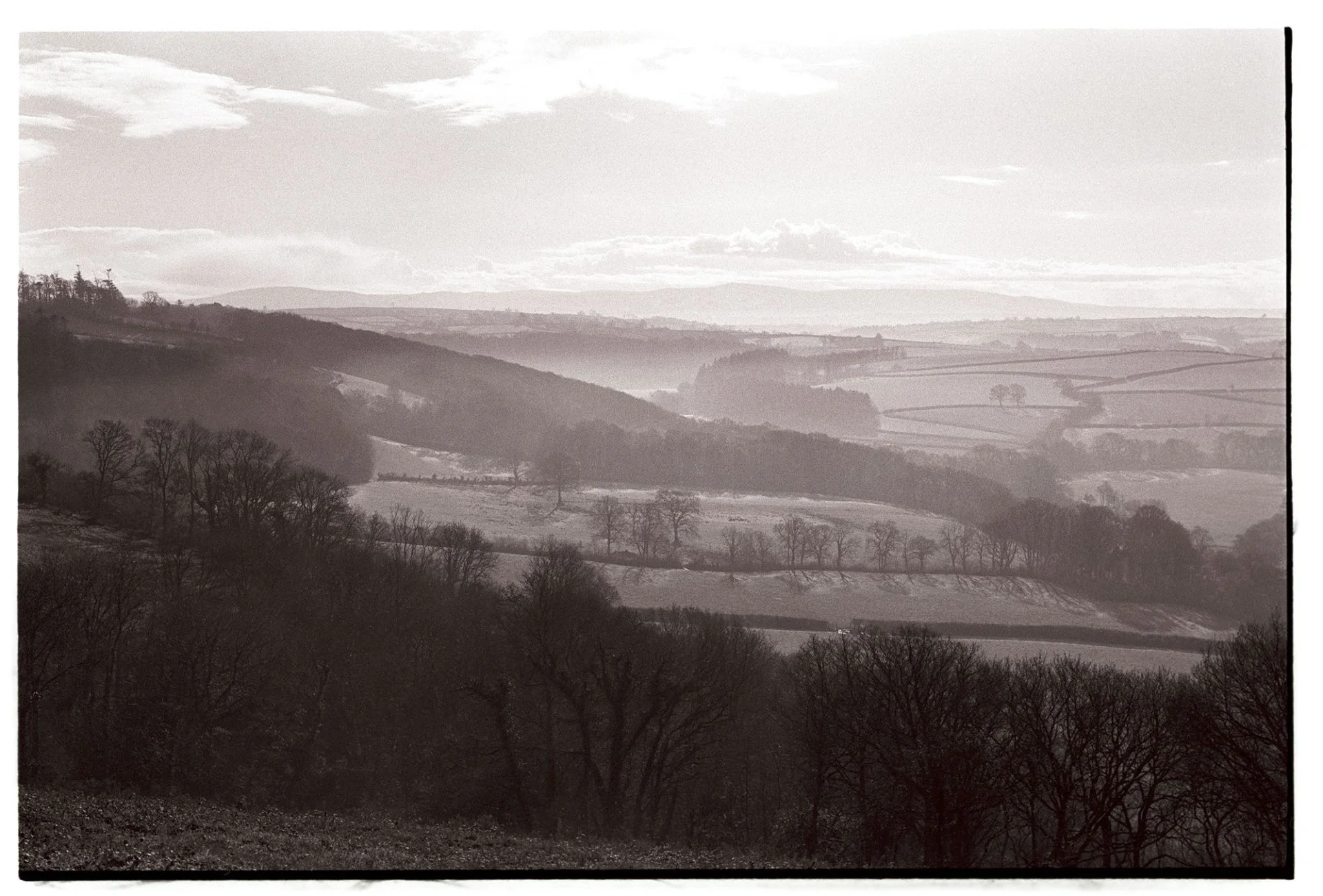
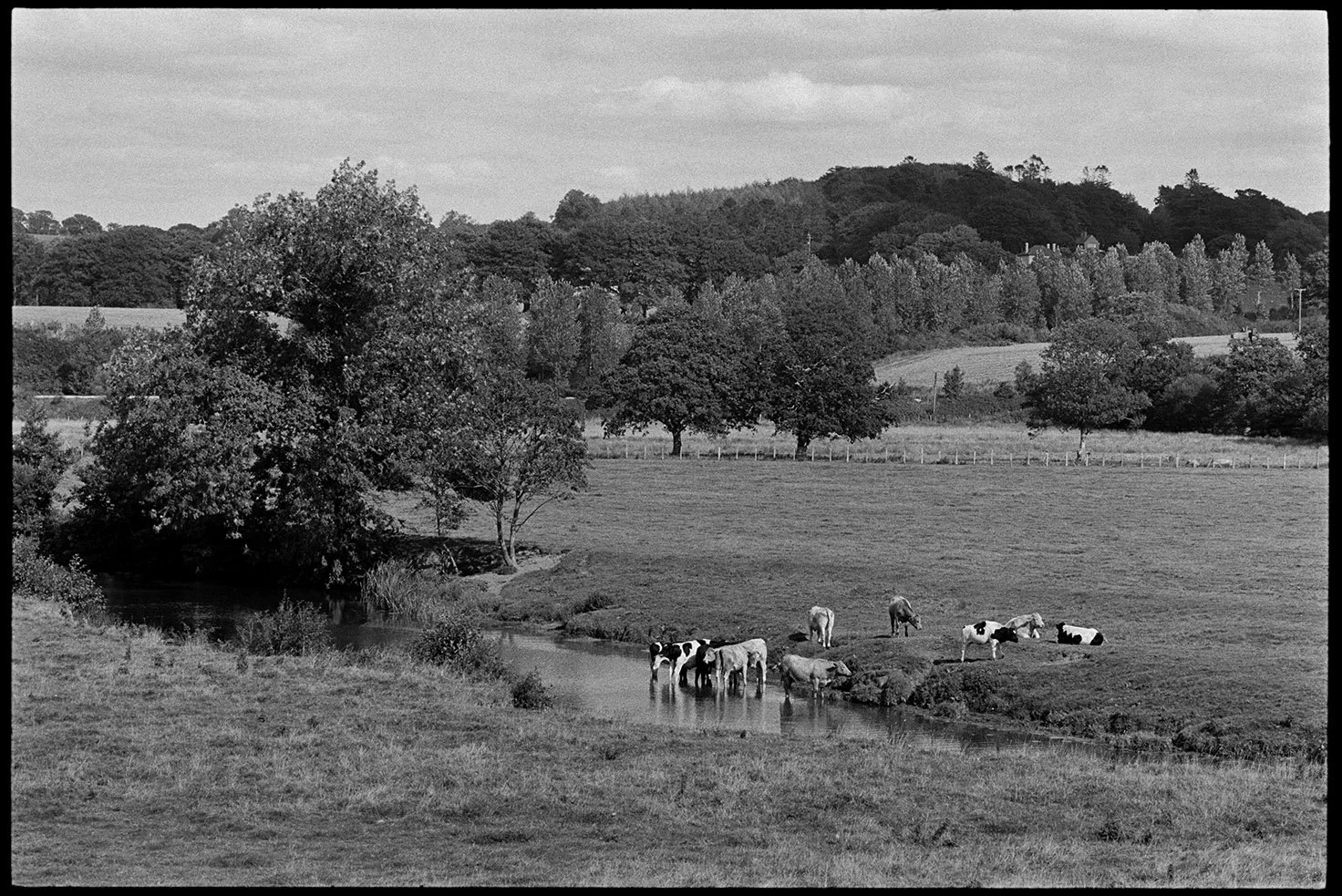
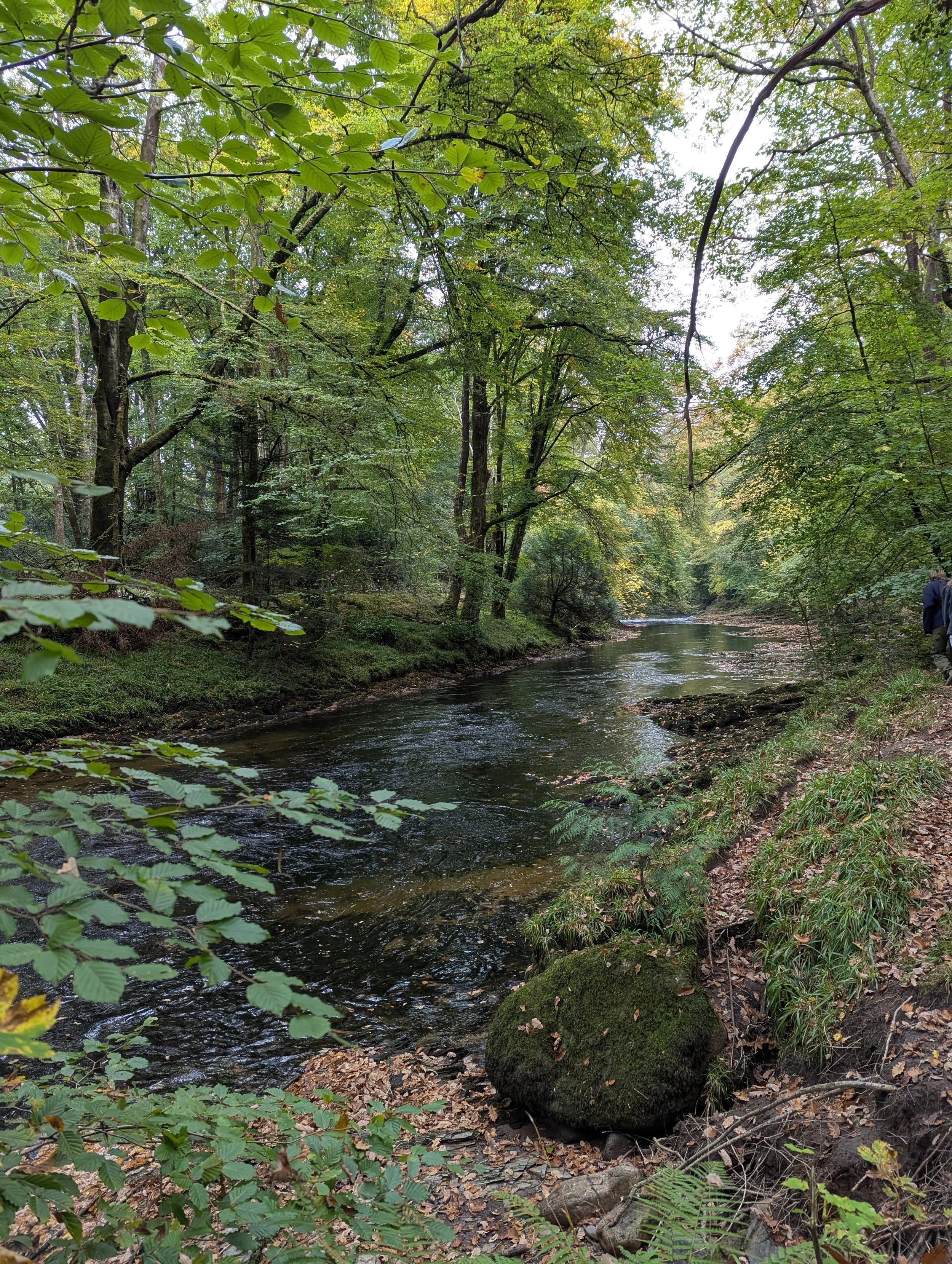
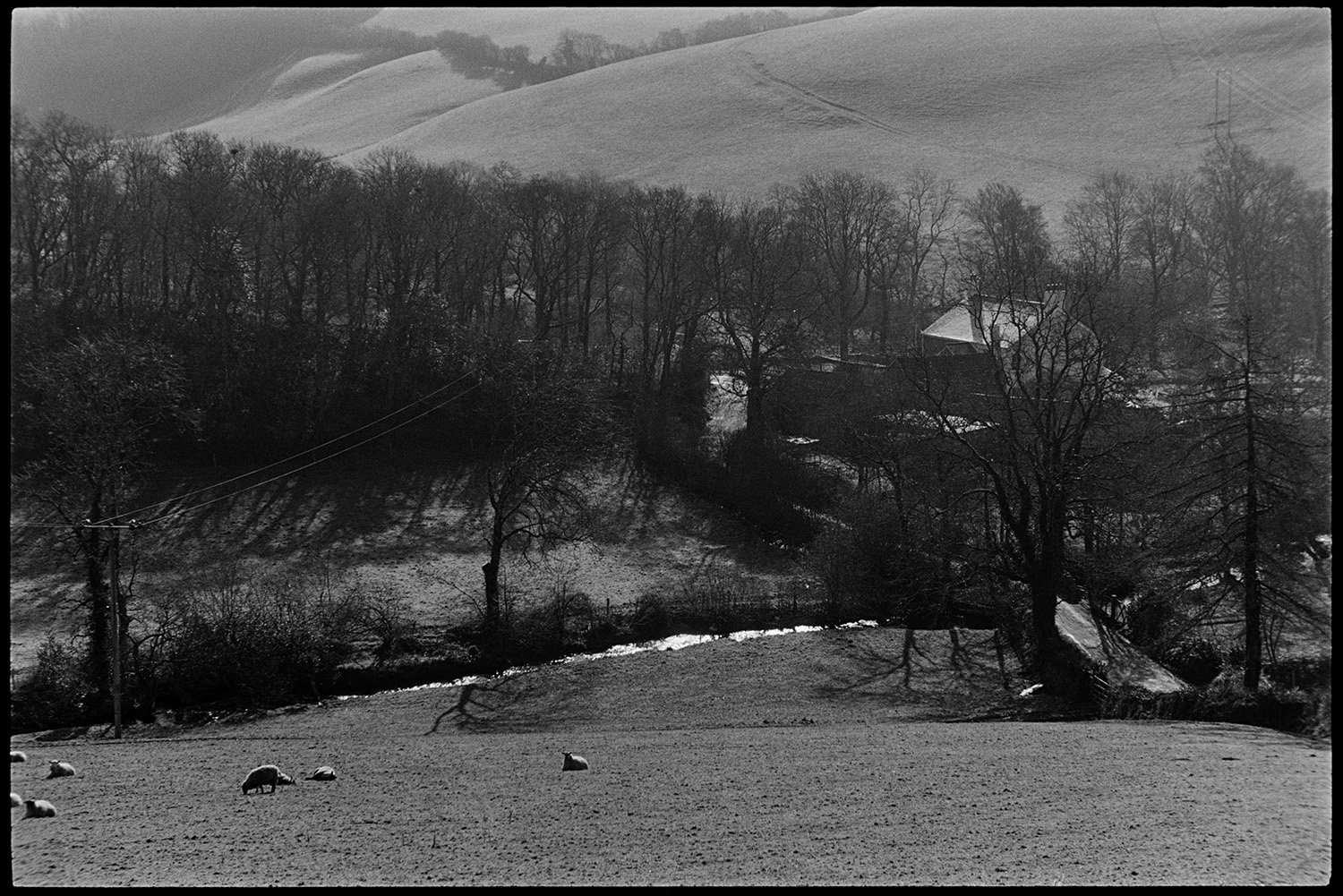
Early morning mist on the River. Photograph by James Ravilious © Beaford Arts digitally scanned from a Beaford Archive negative.
“It will be well for those who seek the favour,
the comfort from our father in heaven,
where a battlement bulwarks us all.”
- The Wanderer
Across the knolls and tors they
heeded this primal melody
and came with their young and
daubed ochre glyphs on crumbling
trunks and carved the throats of lambs
and ran the blood into the rivers and
built their forts and dams. The soil
curdled beneath their feet and eddied
stories in their nostrils and from these
first and oldest rites they gummed their piecemeal
god. The hares hastened their circles and watched
with glassy cosmic eyes as the flax and oak gave
way to turrets of limestone and mortar
and men abandoned their lyres for the truths
of bruised parchment.
There is a man – the land sees him
coddled in wax and shadows – with a
shaven pate and a dead graven god
swinging on a chain from his throat
who first recorded the riddles and
songs of exile, love and war. He breathed
in silence; perched on the bank
of a lake of words, watching the vowels
and consonants lap at the corners
of his thumb. The hares in all their clamour
could not fathom the clasped lips of
a tooth-and-tongue creature and leered,
perturbed, as the man dug furrows and
buried his hours in Matins, Lauds and Vespers –
this strangeness only had a voice
in the sibilations of a sharpened quill
and the trees ogled the hands
plucking thin black wasps
to mash in Arabic gum and pour
that sepia sea into his inkwell –
a quiver full of kennings
worthy of Kinnewolf –
stealing those wanderers
from the jaws of eons, singing lays with
a seafarer’s lung. The local groves granted
chiselled boards to harbour these parchment planes
and the cobalt flax surrendered linen
to stab and seal its chains.
Hour after hour, season after season,
the man toiled and trimmed
and measured and thought and smiled
and died. The book passed hand by hand
until it nestled in the palm of the cleric
of the Confessor – there it remained –
cloaked and crowded on the Bishop’s shelf,
watching the bastard conqueror crack steel
knuckles upon the cathedral door. The angels
and cross-legged Kings split stony eyes
and wept hot mortar to see the book
of the silent man so loudly ignored;
cheap wine began to frill the pages,
a knife was sharpened upon its leather
edge, and the devil’s kiss of a sizzling poker
scorched the hours and days of the monk
into black ragwork scraps. Finally,
in search of a God without a mitre,
they dug in the dust and pig-skin
and proclaimed in fear at the sight of
poetry. Now, Pound and Tolkien can
roll their tongues over riddles and conjugations
and raise red blooms from black soil
and birth a new earth between the syllables,
and a glass-eyed child – clutching a brolly
and chewing his bunk – can stir his mouth
to Fairfax’s tree and talk the century
with a long-dead monk.
This portion was patient awaiting
the poor man’s laureate,
and the ravens chattered and purred
while Latimer’s ally gazed upon
the mad-rat hustings and noted
the manic exertions and chants
of a baying parliament of paupers.
Dickens had come
to jaunt the cobbles of Dumnonia,
and nestled himself, snug and heady,
within the skull of a Turk, sipping lush
and watching a muse slip into slumber,
his long cigarette slipping and probing
like a blazing antennae.
The writer lodged every glimpse
and murmur and passion and stench
and chronicled those motions
into the lines and ledger of his vision –
locked and bound and serialised
behind a pulp-and-paste door –
the ravens cawed and jeered at the man
who always left and always returned
and always asked of this faithful city
if he please may have some more.
Antiquarian, author, songwriter,
poet, priest, friend and fool;
Gould garnered so many names
that the earth forgot his first
and the hares stamped canyons
and spluttered lakes in their efforts
to affix a title to his shifting soul –
marching over the moor dropping names
like some mad Adam – penning hymns
and marking myths and dragging vrkolaks
and vlkoslaks from Satan’s drawer.
Stoker pressed his eyes
to every bracket and letter
of Devon’s mythmaker
in a fevered study of the madman
who first knew
the sting of the fang of Nosferatu.
Grass and gorse and jackdaw and flint
trembled and bit the earth, tightening
their grip on a rattling reality and snapping
their necks to watch bundles of steam
bulge from iron lips as carriages racketed
and raced across the melting ladders –
slowing, sauntering, simmering
to a halt by a man – fresh from tea
with the Queen of mystery.
The scutted temperament cannot conceive
the cleft within a mind devoid of tales –
the rushing tide of apathy
for an intellect craving
a single slice
of spined and jotted glory.
They marked the man, collared
and clad in clarity and missed
the moment – that precise pigment
of the psyche when the devil cries
and a brilliant notion yawps into life
like the cosmic engine of a well-oiled
comet; riddling sloth with bullets
and reminding Lane why he got
into the business of paper and ink
to begin with.
The rain giggled in sheets and rivers
and zipped and shuffled down the glass
in queues, scrumming its brothers
and sisters with all the gusto
of a far stronger current – the woman peered
and shivered within that warm harbour
of canned corporate jazz –
slumped in a café, keying accents,
slashing graves and poking trémas –
the waters mingled, ran and curled,
yucking and braying at a sight so tragic:
a student counting verbs
when she should be penning magic.
These rings and cycles tugged
and tore and those hindlegs ran and
ran some more – eternally in flux
and flex:
abiding, abiding, abiding
in that faithful fortress
on the river Exe.
Documentary photograph by James Ravilious for the Beaford Archive © Beaford Arts.
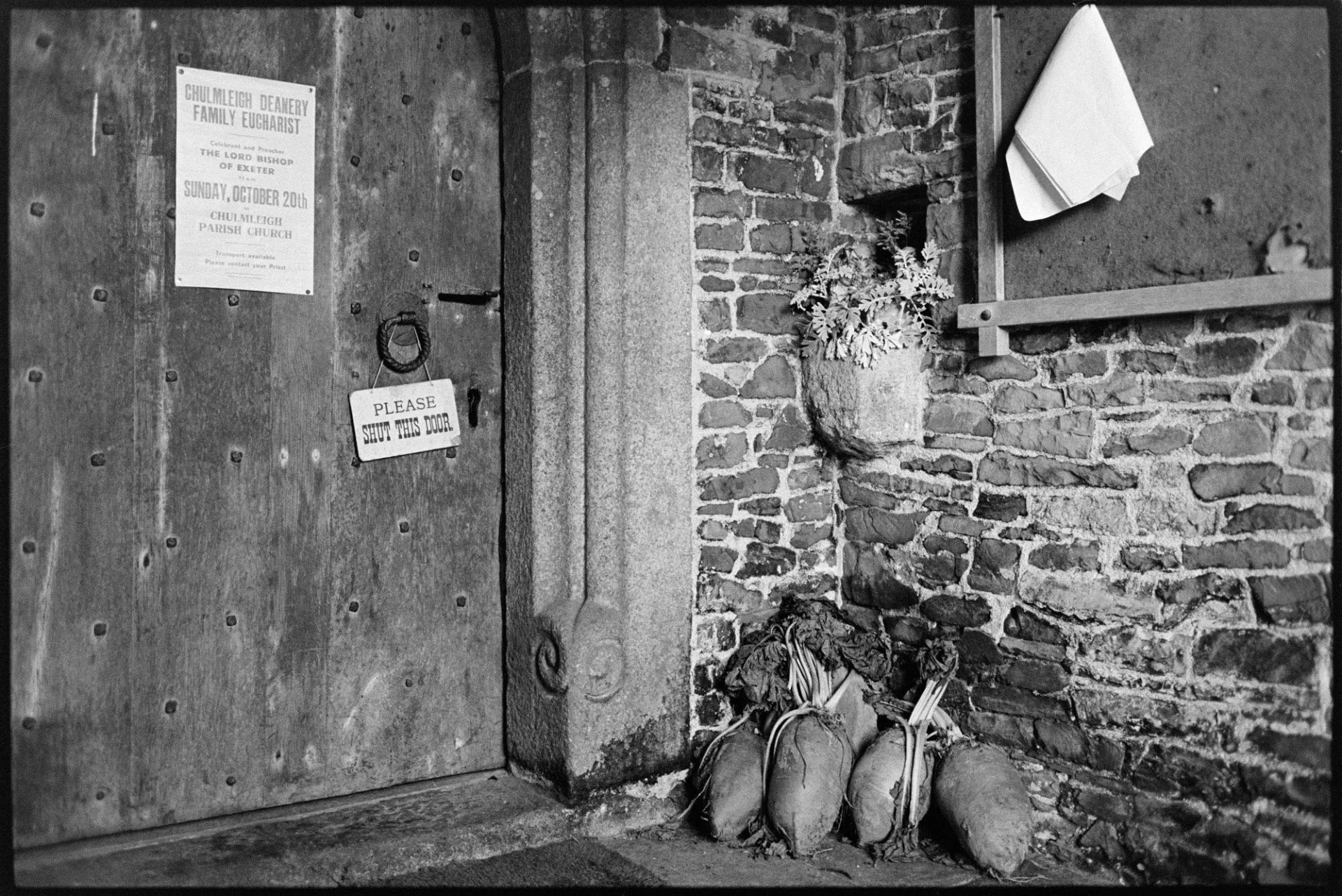
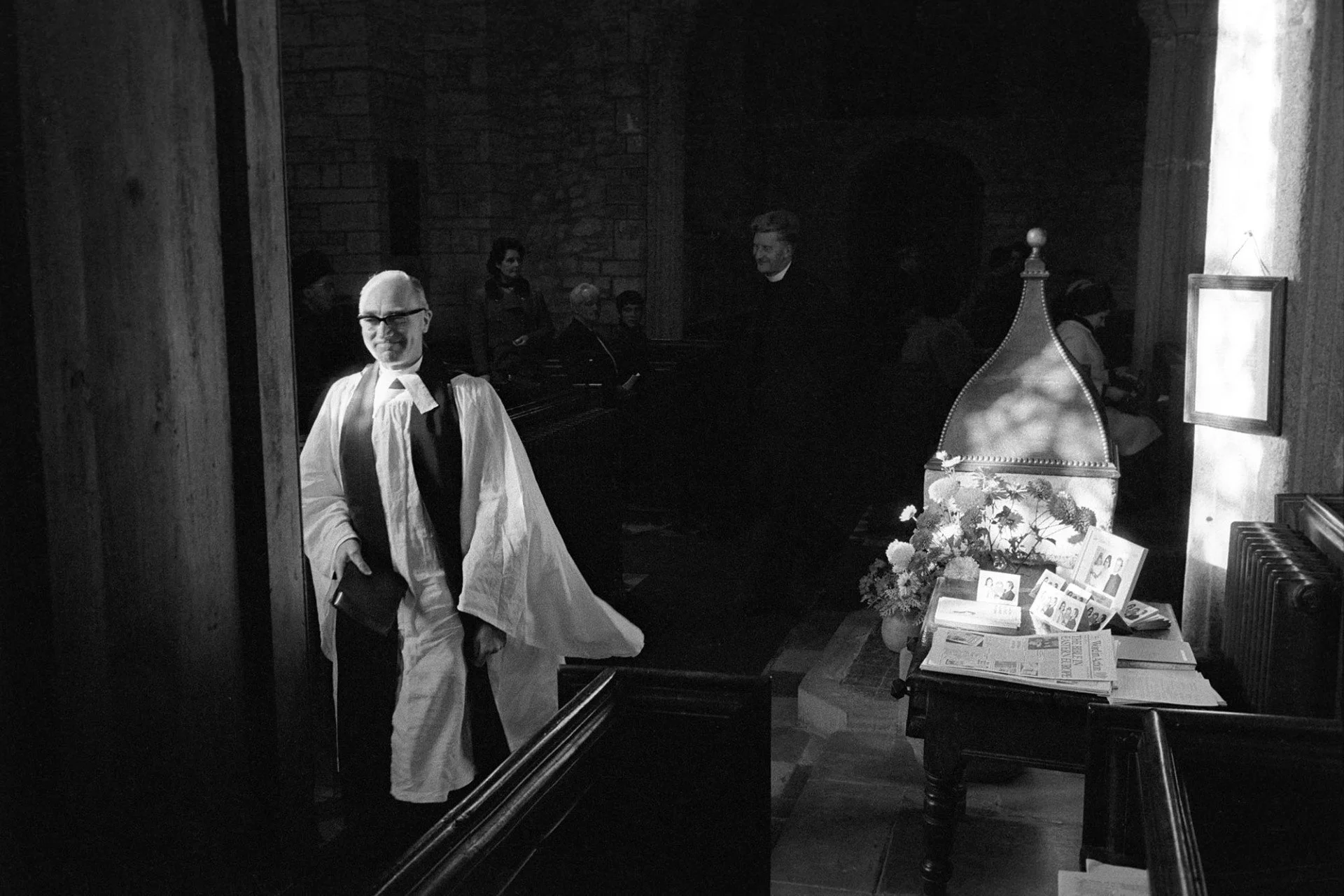
Church service.Photograph by James Ravilious © Beaford Arts digitally scanned from a Beaford Archive negative.
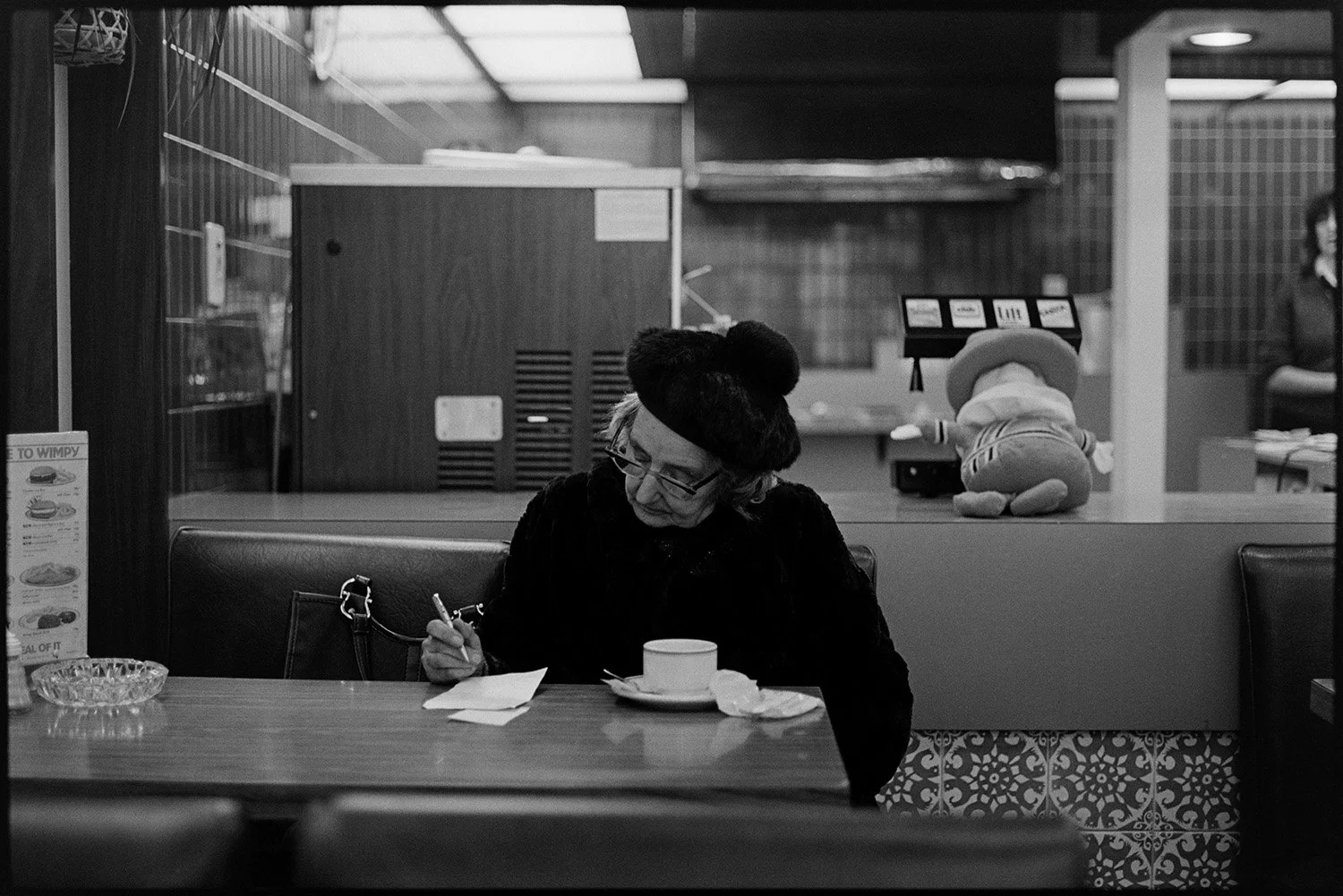
Lunchtime in the public bar. Photograph by James Ravilious © Beaford Arts digitally scanned from a Beaford Archive negative.
“This wall stood long
Goat-grey, red-stained, kingdoms rose and fell,
Surviving storms; high curved arch crumbled.
Now moulders…”
- The Ruin
This earth seldom entertains
the will of its smaller citizens – but
nor does it kill that which insists to fight;
it will bite the bricks and gnaw the
mortar and salivate the timber into slime
and shreds but it will not protest the fresh stone,
hot mortar, new dead shining oak –
do not mistake father time for his scythe
when he carries only illness and it is man
and man alone who murders. Yet this
smattering of stone quarters has seen much
of man and his doings – not, perhaps, the
wars and weddings and frenzied whisking
wheels which wrack and ruin the rest of
civilization; but it has tasted love and
hate and stood quietly by, resting in the lids
of dunnocks, to watch mothers tease their
children and fathers strike their sons and
daughters plant seed after desperate seed
into a cracked and dusky soil. So often
did these circles run, so fond were these
dust puppets of their rites and ritual, that
this earth hardly noticed the arrival of Jonson’s
protégé, with his book and his quill and his sugared
dreams of God. The land was sobered and shaken
by concertos of lyric and ligament and found
its flowers weeping and its roots chuckling
at the flagrancy of his verse – a man with eyes
to see the liquid silks and unplucked roses
of youthful glee. When the wigged masses
traded tradition for mouths and blades, this son
of the ancients rebelled, and the bluebells wilted
to witness Herrick leave in scorn his chapelled home,
decrying his people’s primitivity. The earth shipped
many a lark to watch the poet’s progress,
and carried stanzas back to the grass on the backs
of feathers and fleas – until the poet,
succoured by life, traipsed home to die.
Though the slab atop his chthonic bed
lies lichened and empty, the earth remembers
the songs of Herrick and would forgive
his discontent for the chance to hear
one more melody. Today, the only noise
in that hallowed ground is the passing whine
of black-clogged cars – distraught
and abandoned, the land cries:
gather ye rosebuds while ye may,
before you are tarred and graved
into the common man’s motorway.
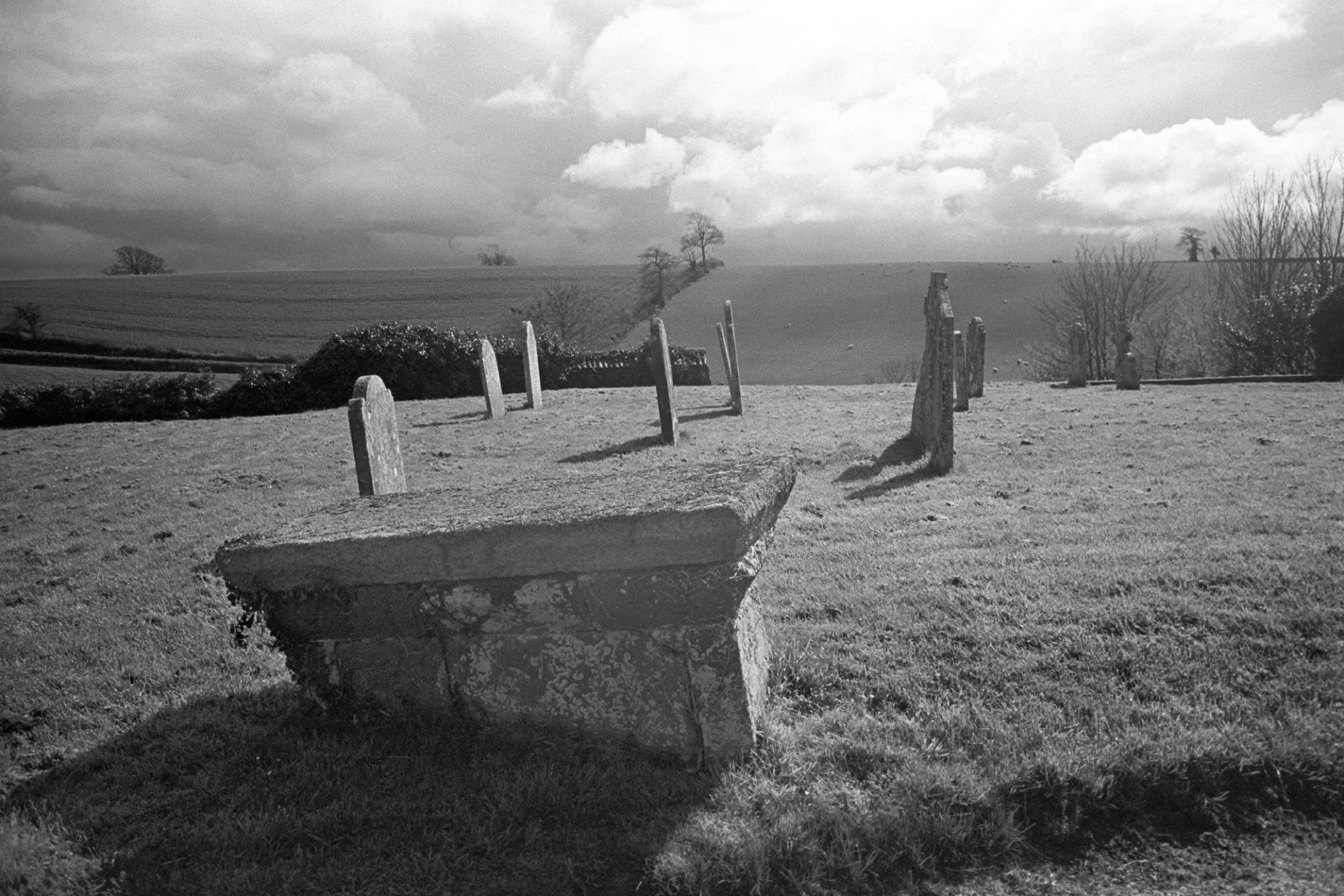
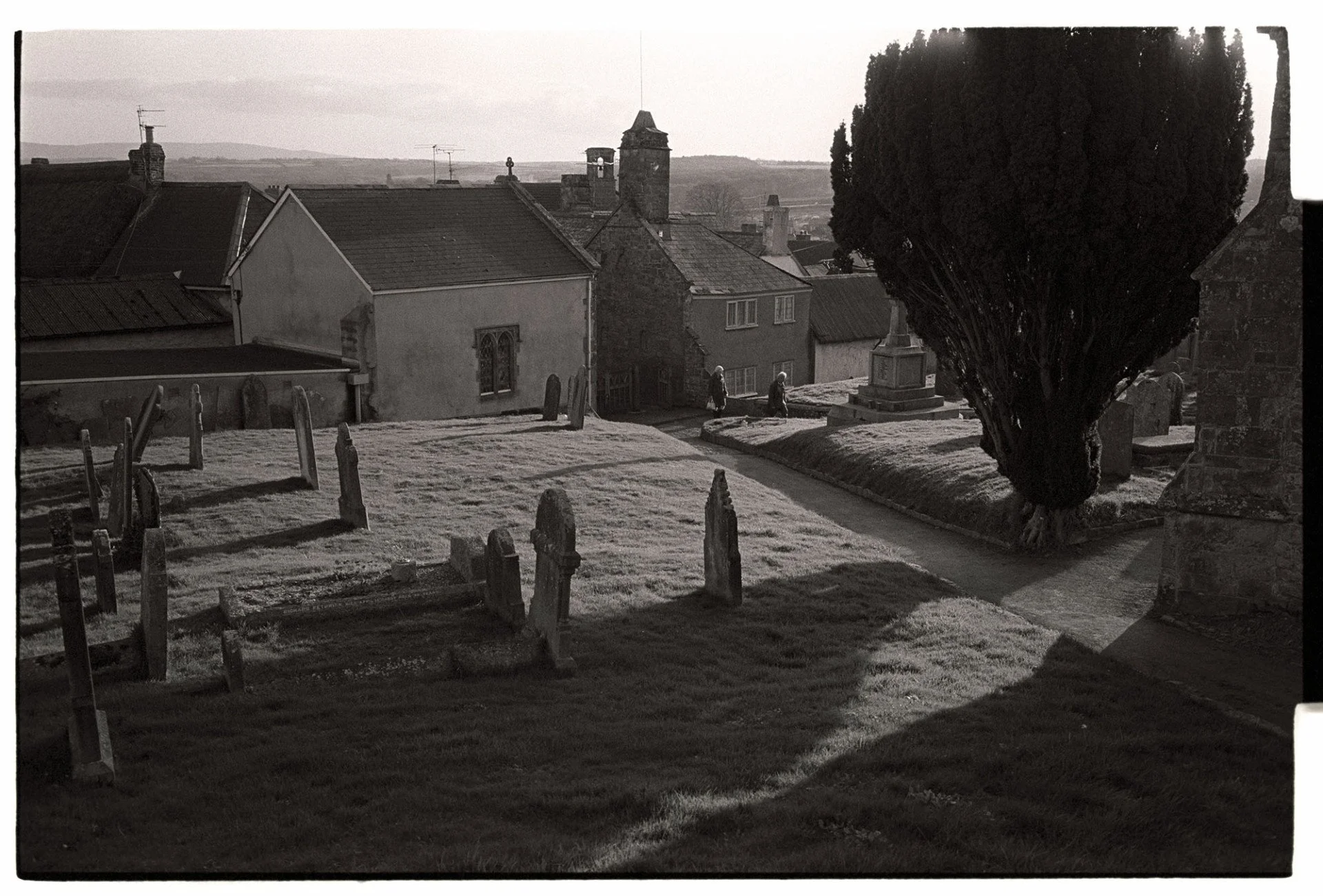
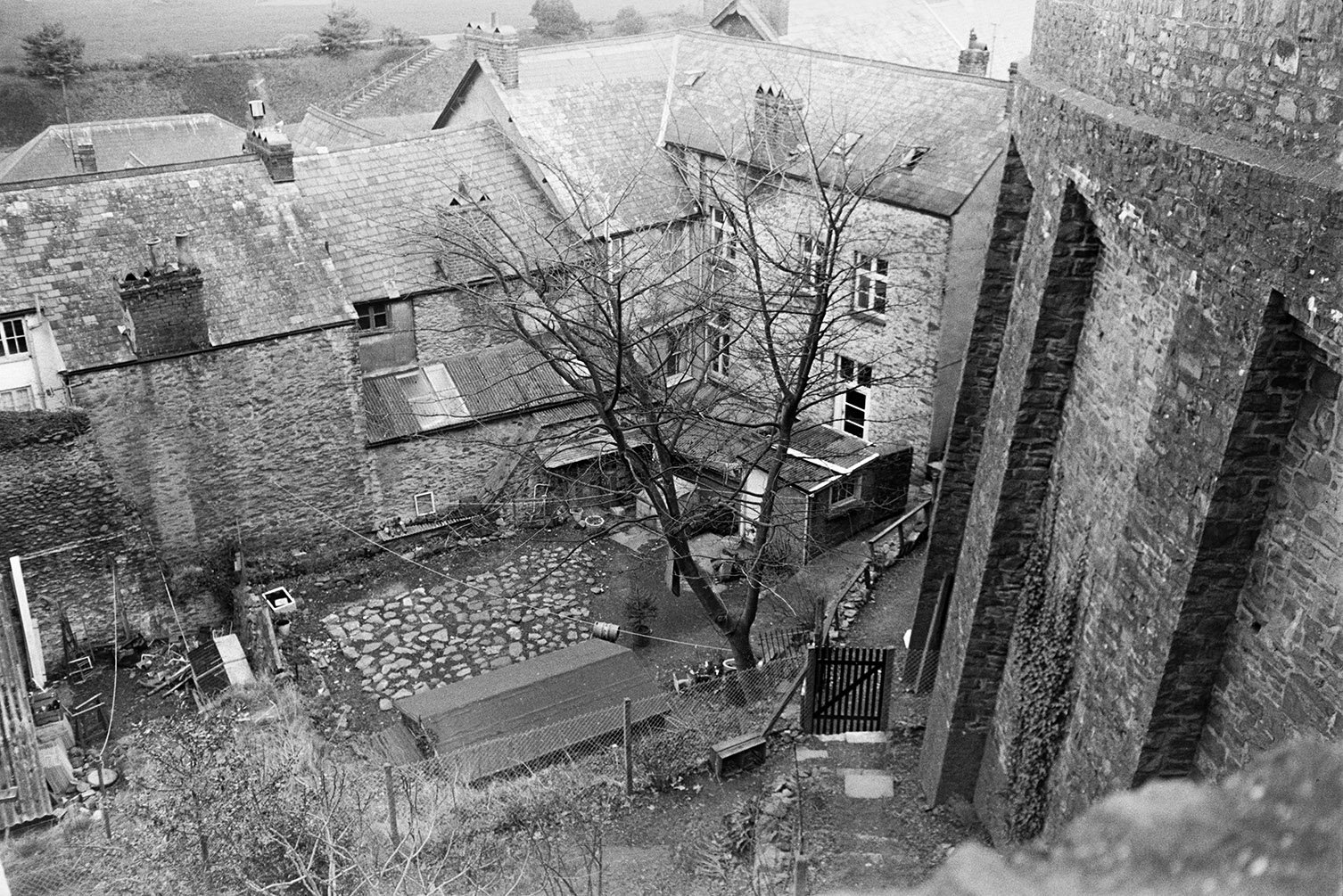
The churchyard. Photograph by James Ravilious © Beaford Arts digitally scanned from a Beaford Archive negative.
Documentary photograph by James Ravilious for the Beaford Archive © Beaford Arts.
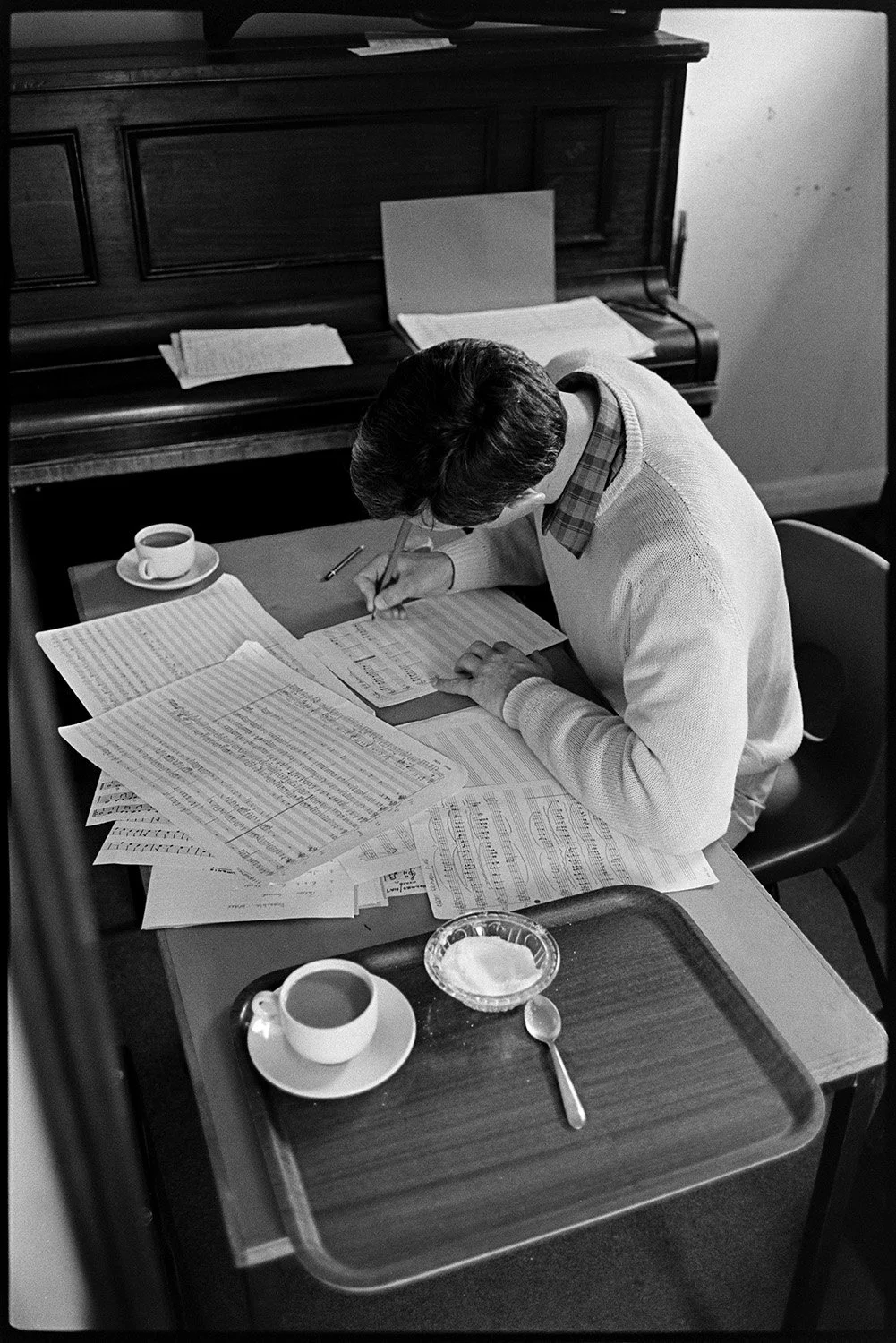
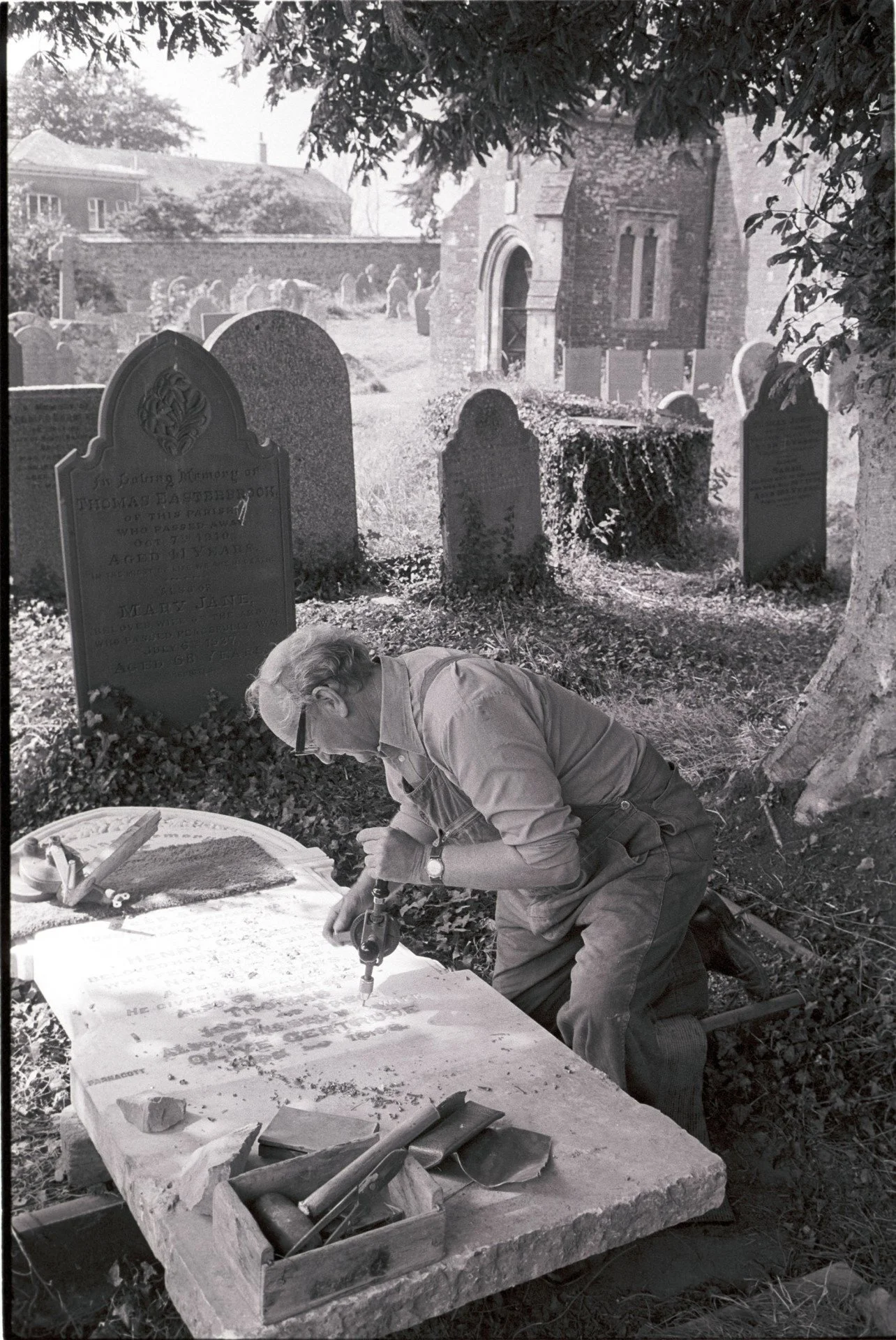
Bruce Edyvean adding to an inscription. Photograph by James Ravilious © Beaford Arts digitally scanned from a Beaford Archive negative.
“A man skilled in song, received the land-rights
That the refuge of warriors erst rendered me.
That passed away; so may this.”
- Deor
The glory of the western sky
and the warm red earth below;
holts and hives and labyrinths
cast in a vaulted glow –
perhaps that is what first drew them
in their hordes and gaggles; mini men
banished from old circles and barrows,
with lumpy rags and spiky eyes,
pecking stardust, burning barrels,
frolicking and chirping and rocking,
pinching colt ears and twiddling manes,
tricking wayward infants into little thanes,
searching for another laugh to replace
their roughshod churlish giggle –
how could they suspect?
That their piskie holes and caves
would buckle under sabatons
when men arrived;
those Cromwells and Fairfaxs
chewing grease and grit and toasting
thick goblets thicker still
with the blood of Gaels and Irish spit.
Fear the peals
that ring circles for a smaller world;
the piskie droves knew their end was near
if Adonai reared belltowers to see and hear,
but dreaded more the youthful bard,
born squealing verse as fat as lard;
those clumsy rhythms pared and grew
into odes and sonnets and rime,
and that was when the piskies knew
man’s tooth and tongue
would rule the rest of time.
Still, they watched him
and sent Arabian spectres
to shake his cot, and later tipped
his opium elbow, brewing poppied fancies
and then chuckling sorrow
when all their efforts to mire
and muddle that lyric man
only birthed his Kubla Khan –
they despaired and fled to their runted parlour
and the poet hastened his preaching
for conversation’s verse –
shilling Kant and Shelling
for a penny pauper’s purse.
If you peer down Oteri’s cobbles
where the piskie song now limps and hobbles –
that ancient noise is bent in thrall
to salute that verse
which blessed us all;
every creature and every craftsman
both great
and small.
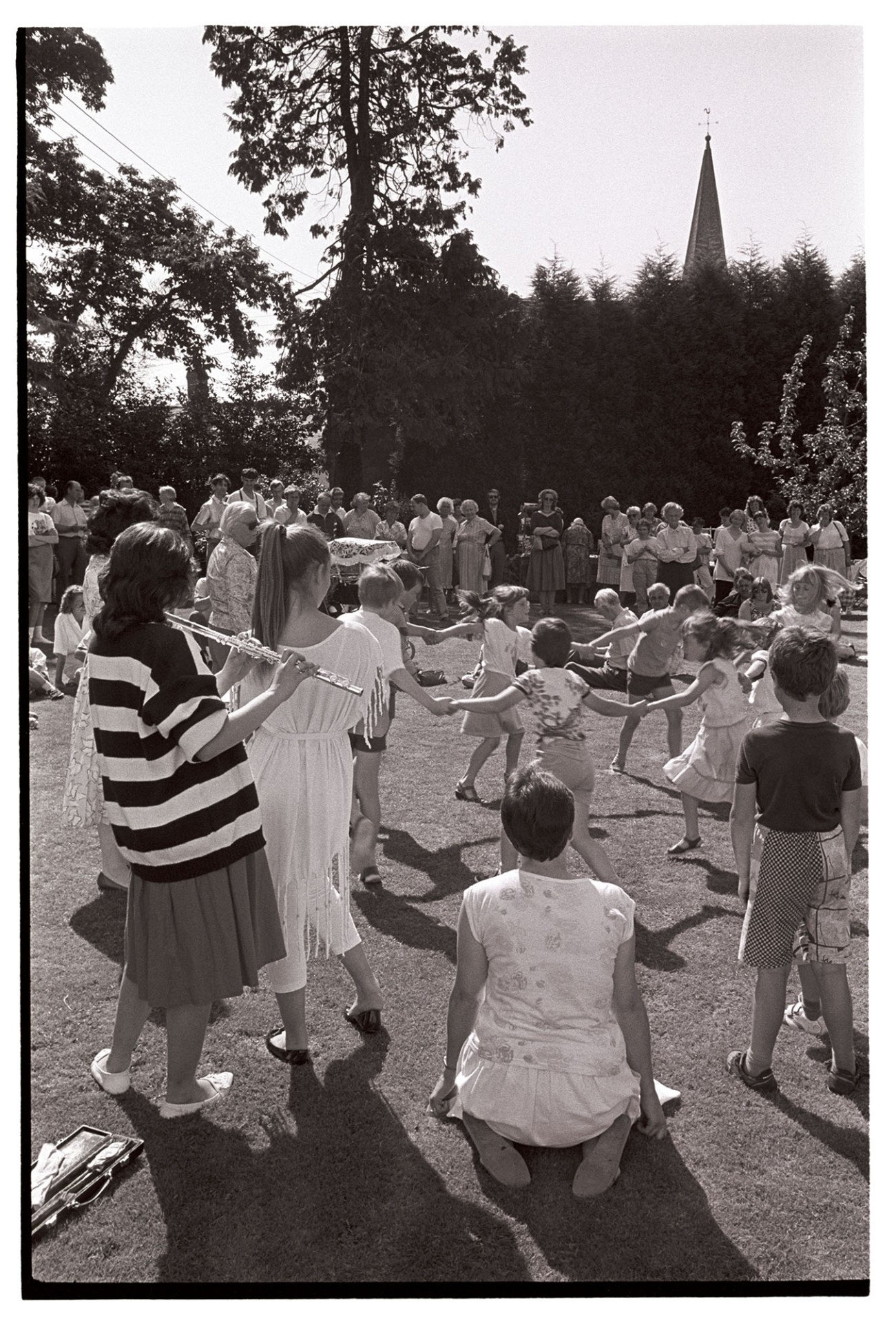
Vicarage garden party. Photograph by James Ravilious © Beaford Arts digitally scanned from a Beaford Archive negative.
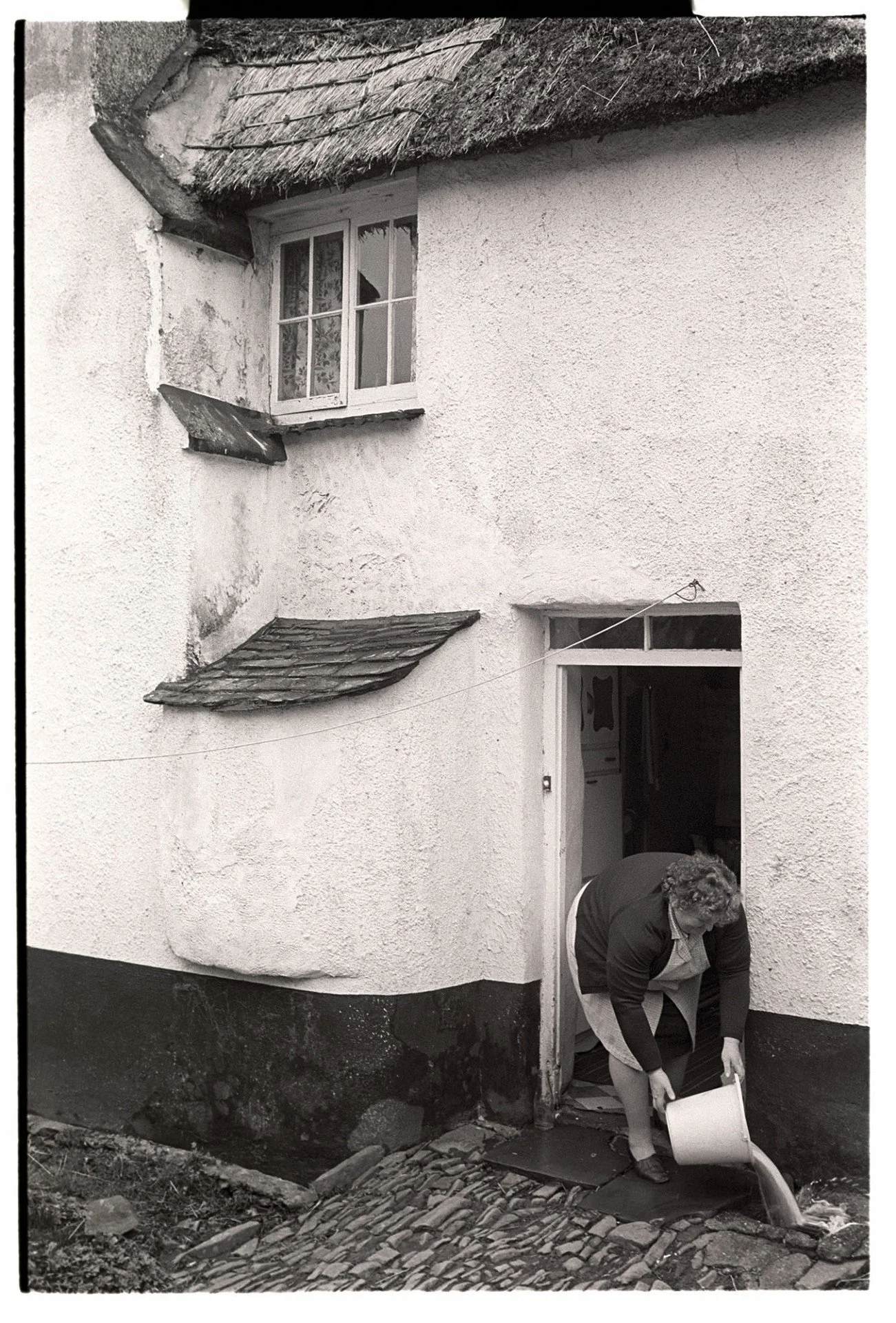
Cob and thatch cottage. Photograph by James Ravilious © Beaford Arts digitally scanned from a Beaford Archive negative.
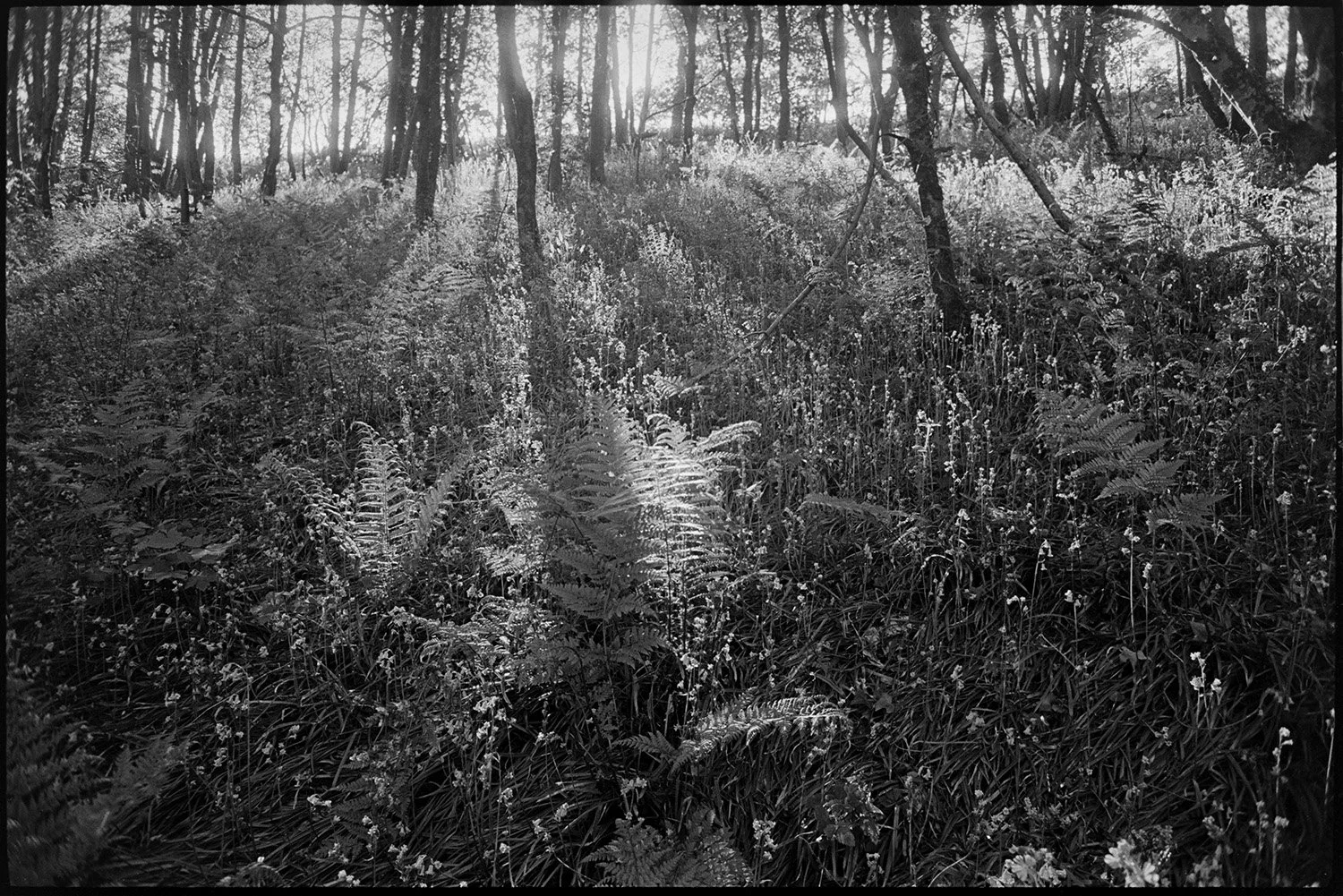
Rushleigh Wood. Photograph by James Ravilious © Beaford Arts digitally scanned from a Beaford Archive negative.
“I am worthy to folk, and found widely,
brought from forests and fortress-hills,
from dales and from downs.”
- Riddle 27
When walking through this royal forest
be wary of its king –
red-ruffed and crowned
with lance of livid bone –
he witnessed the first smelting
of iron and bronze and scratched
the first scuff atop Tarr’s stone –
no cairn, nor crypt, nor copper mine
escaped his liquid crystal eye –
no steward, warden, or forester
could soften his primal cry –
the phantom cat
would never tag a hind –
the hares themselves
would never tempt a chase –
or else risk their circles
stamped and crushed without a trace –
it is known and recorded in this valley’s annals
the sun itself wilted a paler yellow
when the sky first emptied
for their thundered bellow.
So count your step
over the moor’s crannies and crags
lest you slip
and meet Exmoor’s stags.
To the north of the moor,
lies one of Brutus’ fallen foes,
massive calcium fingers stretching forth,
great stalactite ribs, bleached
and exposed – pecked clean
by the rain, the goats, and Father Time;
caught and captured in divine repose.
Wordsworth and Coleridge walked the vale,
and knew its packed and balanced peaks
contained the kernel of the oldest tale;
they knocked their heads and penned their
riff and refrain, to illustrate for the masses,
the eternal wanderings of Cain.
The king of the moor chewed the sedge
and mocked the poets in their pledge –
the piece was never clean nor complete,
how, after all, could they trace Cain’s retreat?
Whilst still marred and marked,
he held death in its defeat,
and the fugitive watched the poets himself,
still wandering, still roving,
still fleeing over and over
this valley’s flinted seat.
Across the mist, the last Victorian marched
along the guggling brook –
the stumps and stones of Badgworthy
never knew the man who took
that ancient, storied valley –
once beholden to the river’s tune –
now known for that portended name
that moniker, that bloodline,
that ‘Doone’.
Between litigation and allotment,
Blackmore had little time for saga
or syllables, but could not rid his mind
of carvers and weddings and knew;
a romance was not beautiful
simply because it was true.
Though his other works languish
and wallow in the muse’s ether –
if ever he saw that novel
still splayed in countless hands,
anxiously thumbing – perhaps
he would have smiled, even when
he chilled and seized and knew,
the frost was coming for him, too.
Documentary photograph by James Ravilious for the Beaford Archive © Beaford Arts.
“The tides beat the shore, flung there at times
onto the stones and the sands of its cliffs
the weeds and waves, then I am struggling,
covered by tidal forces, rousing the earth,”
- Riddle 2
It is a pretty thing, indeed,
to be loved by painters of any creed –
the mouth of the torrent curtains down
the valleyed oesophagus – myrtle-clad,
rose-clad, folding and folding,
a frothing, spitting steed –
this two-headed flux
is sea bound and singing,
carrying pithy courtship
and crushing calamity
within its smaller twin –
this surge, this beast,
this Lyn.
He came with his entourage
to flee the pillow of state;
thirty cottages and a fort
of Myrtleberry – a home removed
from tyranny’s fate.
Nestled and kneaded
in sweet river whispers
and wind whistles, Shelley
ogled whitebeams and came to know
the flood of ages combatting below –
he taught his words to battle and balk
and sent them on the Devil’s walk,
and when news returned that the
brass had seized his faithful Hill,
this man – this foppish rebel –
could not be still, and wrote
and cursed and fled to Tremadoc,
and left the torrent his cosmic bill.
The river watched and held its tongue
but later slashed its liquid lung –
a century, hence, it remembered to pay
and chose this cosy idyll for its prey –
great rabid suds and seeking waves
pried the banks and sought the graves.
So now, abstain from reciting his lines:
for all must ask in fragile breath,
how wonderful –
truly –
is death?
Documentary photograph by Roger Deakins for the Beaford Archive © Beaford Arts.
“I have wrought these words together out of a wryed existence,
The heart’s tally, telling off
The griefs I have undergone from girlhood upwards,
Old and new”
- The Wife’s Complaint
When they cut and hollowed the tor
to brick-and-mortar God’s house,
the land did not expect its excavated limbs
to be offered to every convalescent
whoever coughed up a kingdom. This
was where they shipped Browning – broken
and disowned – hacking up heaven on the page
in blushing stanzas. The land was satisfied
with her verse – the dying know how to live –
the bolted body bestows a key to the heart
which loves in ways immeasurable by depth
or breadth or height. They sent her for the sea,
and it received her coldly, pruning its foam to spit
through the shutters, tickling her black-flamed
brain with salted digits. In turn, she taunted
the ocean’s melody in its sevenfold cadence
and the waters ground their mossy molars
and drew their steel and knocked a wrothful palm
against her brother’s keel. He was adrift in the deep,
trusting fate to timber, rudder and bow
when the sea mocked the love of a poet
and dragged the man in pearly chains
to bite his eyes and barnacle his brow.
Browning chose to hate the land
of waxing stone and dread the ocean’s breath –
yet the sea was victorious only in hewing
a more profound poet; eating her edges
and polishing her marrow – like a sculptor
pulling patterns from the rubble – now
she steels a brittle spine and places pen
and ink upon the page and brings forth
new oceans and the waters of the tor
issue no reply.
The sea chanced and waited until the Millers fled
the new world to till the sands of Torre, where
amidst the lint and melted rock
they fed a child with story –
there was a leisure to this life, a civility:
a silken middle-class weight which hung and swung
like a hoop on a chain, and the fingers
which clutched the petticoat and boater
made shadows on the wall and imagined a world of death
behind the smiles and perfume and dignity – a stench
which dilates unseen – yet still she recited her ABC’s
at the Princess Gardens and traded two-pence
for the chance to skate the pier and pirouette
atop the dying planks where below the lichen,
coned and spiraled mouths crushed salt-crystal tack
and knocked their tongues against the pillars –
but what is the sea to a child? Just noise
and froth tickling on the sweetest day of Summer;
Christie was thirteen when she nearly drowned
in the Beacon’s maw. Yet the sea was thwarted
by an old Sea Horse smoking a pipe,
scratching his beard, committing miracles
and dooming forests to the page. Christie was only
ever outsold by God and Shakespeare; fine company
for a child who dreamed of music, yet the calligraphy
of ligaments evaded her careful hand and the universe urged
a love for the quieter composition. So she watched her fellow
watchmaker and became one herself, teasing cogs and chimes,
learning the orbit of the soul of man –
that infernal, needling
tick. Christie knew
the devil was balding –
that Satan wore perfume and dined at three –
and she took that knowledge
of daggered smiles and poisoned handshakes
and turned it into mystery. While cloistered
in sanitized rooms, dispensing powders,
serums, antidotes – the sea wondered
when her mind slipped
from the gentle snakes of Asclepius
to ponder the boomslang’s venom –
when the hand which gave
contemplated the weight and purpose
of the hand that took. After all,
amidst this linted landscape,
her mother carved a pastel paradise
and Christie chose to write bodies writhing
in the earth next to her childhood. Why
be afraid of anything but ignorance,
why worry about husbands clutching
their knives? When you can play with death
while you knit – each purl and cable
a disaster in imagined lives.
Christie understood
beneath her wiles and her wit
there was a golden maxim amidst the cruelty;
take what you want
and pay for it.
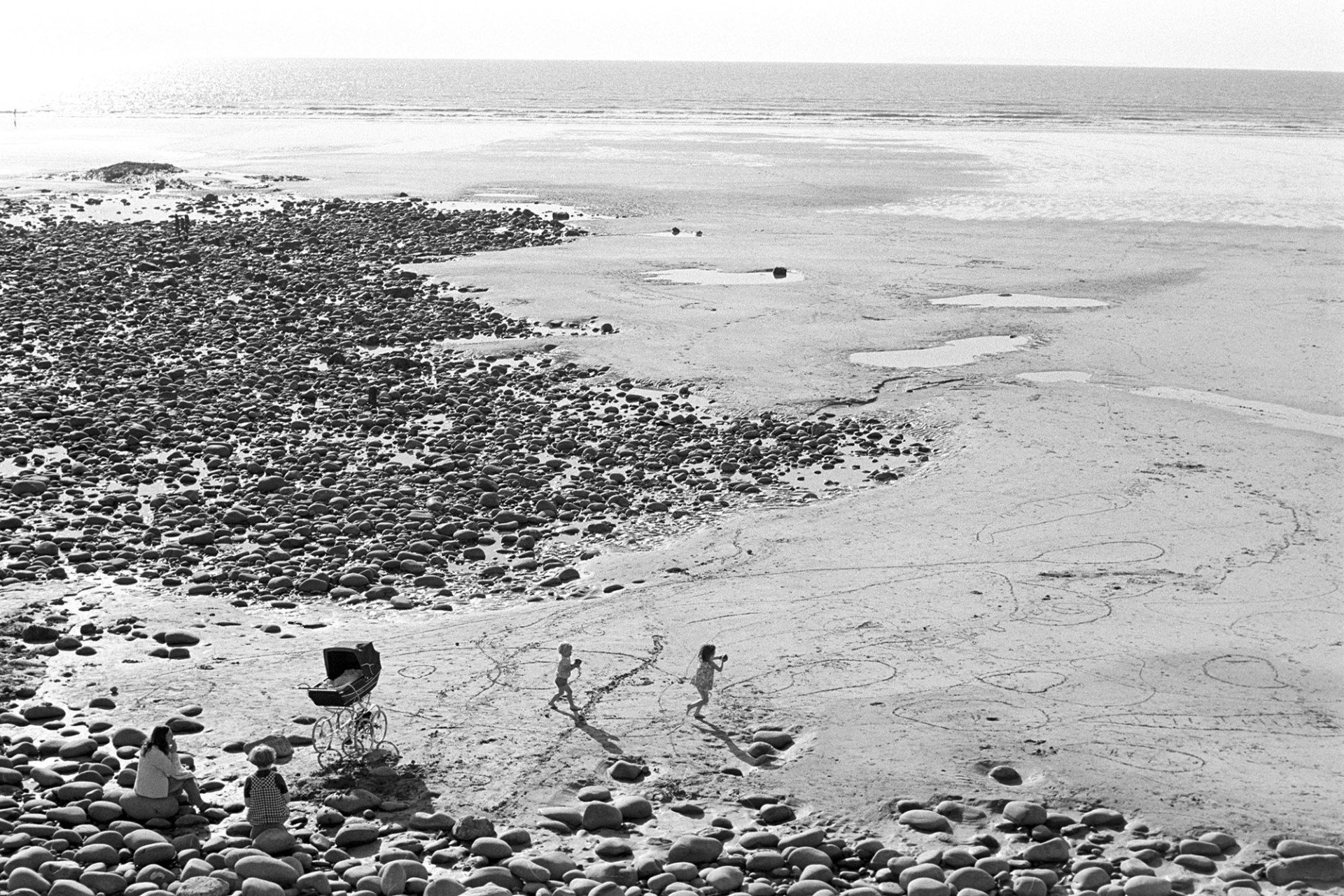
Mothers and children on the beach. Photograph by James Ravilious © Beaford Arts digitally scanned from a Beaford Archive negative.
Documentary photograph by James Ravilious for the Beaford Archive © Beaford Arts.
“His thought is not for harp nor taking of rings –
Nor happiness in wife nor joy in worldly things –
Nor for aught else, save the surging waves;
But ever does he yearn who seeks the sea.”
- The Seafarer
The salmon ran like crusted tapers –
a fleshy armada – massing
on the borders of the oak ensemble
to launch and flame the Torridge
In their efforts to glimpse a brick
of the pale town on the water juncture –
where they furnished seven ships to char
the Spanish and endowed paunchy Brittania
with commerce and colonies and three
snapped necks at Heavitree. A hare’s eye,
cannot distinguish between once, now,
or soon to be, yet dwelled long and often
upon the writ and preaching of Charles Kingsley –
who rears quietly upon the quay, marbled
and balding and grey, whilst nearby,
Rose Salterne drinks and drowns herself
for another day.
To the north, lies a submerged forest;
eight-dozen severed trunks, salt-smoked
into black stubs, now freshly swept into
a shore – here is where Kinglsey first dug
his heels and devised fleets and fame –
a port for the common mariner to seek
foreign riches and domestic acclaim.
He loved this slice of shingle and sand,
and slipped and clattered up the pebbled ridge
with quarrymen in tow, to strain and lift every boulder,
and examine the fauna pocketed below –
no skater nor sea-pie escaped his admiring gaze
and yet an emptied idyll never pays;
Kingsley discarded a friend and lost a muse
when they stacked a village in his name;
we must ask would he still write, if he could know,
that he would carve a new Westward Ho?
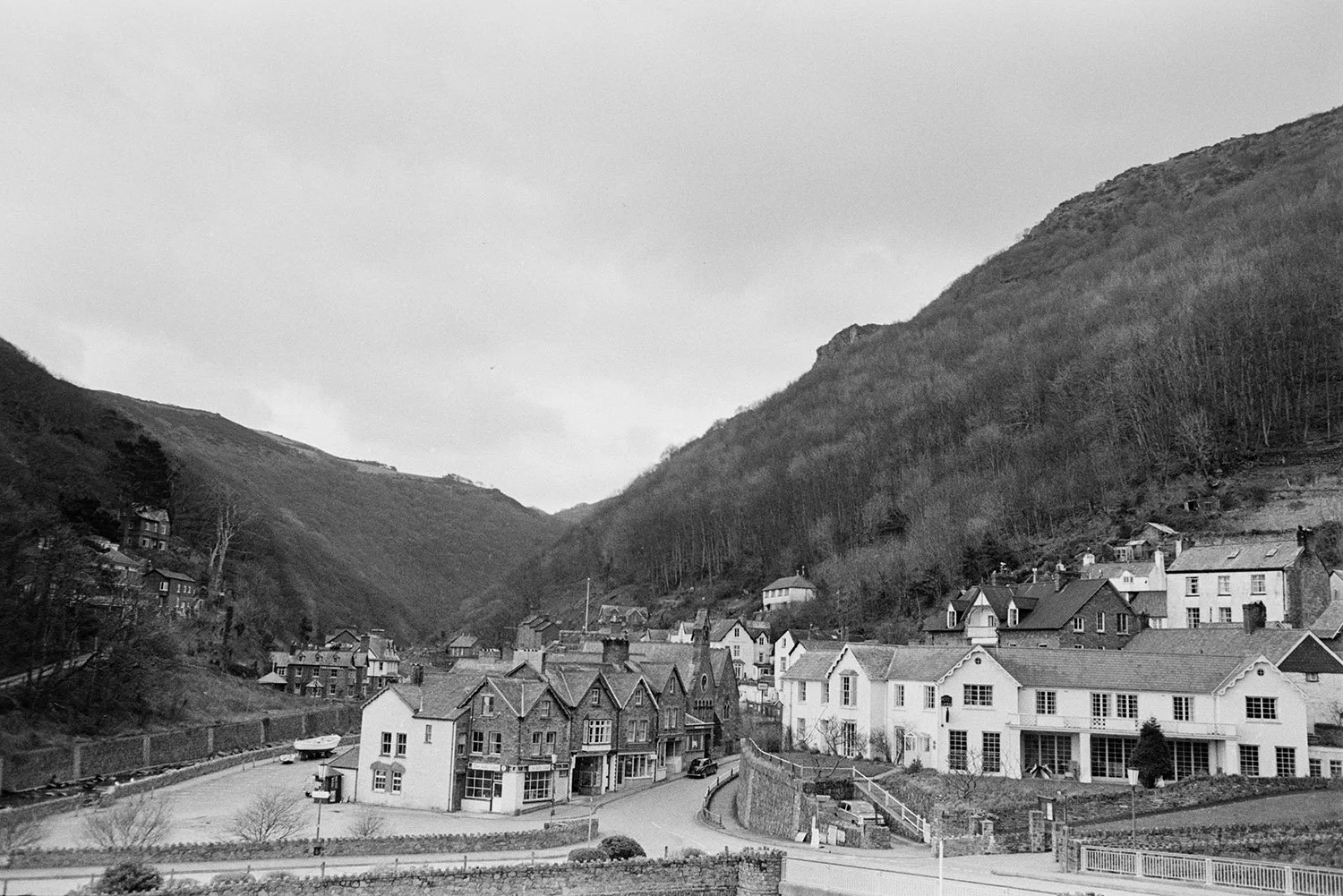
Perhaps there would be nowhere for Kipling
to go – and the world would be starved
of the antics and capers of Stalky and co –
fleeing the torment of Lorne Lodge,
Kipling came to drill and conjugate
and mime the imperial motions
upon the ocean’s edge – yet more
important than those stale notions
were the author’s own violent emotions
when upon the sound, he spied a blossom
he could not forget and from that light
spun and wove a literary debt.
There is much to be won and witnessed
when stationed by the sea;
it is here that the hares often forget
their orbit and feign for a moment,
or a century, that they are sprinting
once more wild – once more free.
Documentary photograph by Roger Deakins for the Beaford Archive © Beaford Arts.
Documentary photograph by James Ravilious for the Beaford Archive © Beaford Arts.
“The air bears little creatures
over the hillsides. They are very black,
swarthy, dark-coated. Bountiful of song
they journey in groups, cry loudly,
tread the woody headlands, sometimes the town-dwellings
of the sons of men. They name themselves.”
- Riddle 57
Should the poet ponder the head of Jormungand
Or it’s flaying, punctured tail?
Where indeed to find a beginning or an end,
for that which never sparked or ceased?
The philosopher – the mathematician –
all must agree, that when trying and failing
to measure a ring, a sound, a thought, a circle –
they must abandon this first and oldest riddle
and draw a border
right down the orbit’s middle –
to pass hand by hand
on Mongol coin and Persian textile –
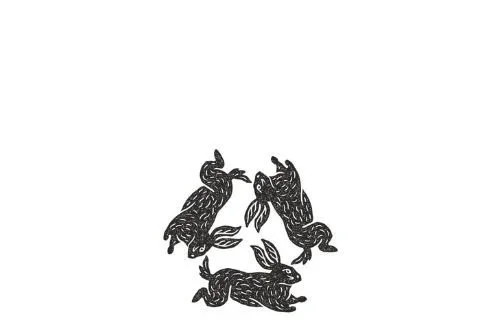
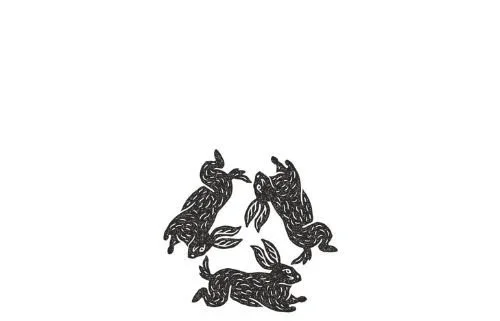
the hares which ran the circuit of the Earth
and came to rest on boss, headstone, and tile,
but why – they cry,
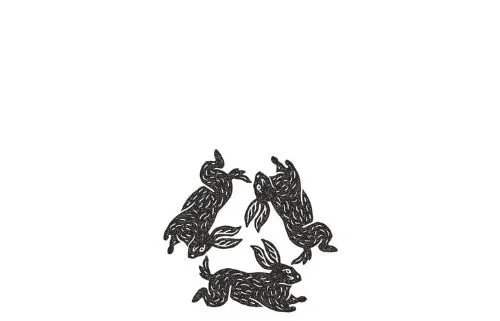
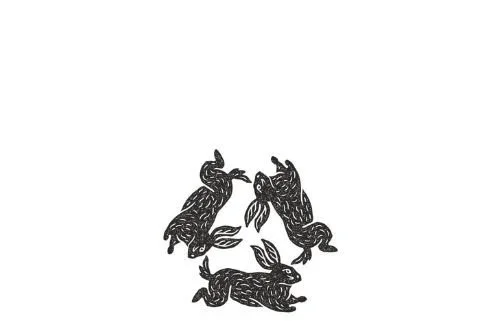
is there always three?
Three nails in the palm of Christ
or three distinctions to the trinity?
Perhaps three jewels to rend Samsara
or the three Pure Ones of the Dao?
When pacing the three paths
which lead to Hecate,
they ask,
is this fertility or infinity?
Is it three branches for every tree
or three notes to shape a song,
perhaps three bits to every key,
or three sides to every story?
You ask and entreat and beg
for a tedious, tenuous clarity,
but is it truly a wonder, my friend,
that those three hares –
that shape-shifting mystery –
might sprint a candid chorus
hale but hoary
of sweet Dumnonia
and its eternal glory?
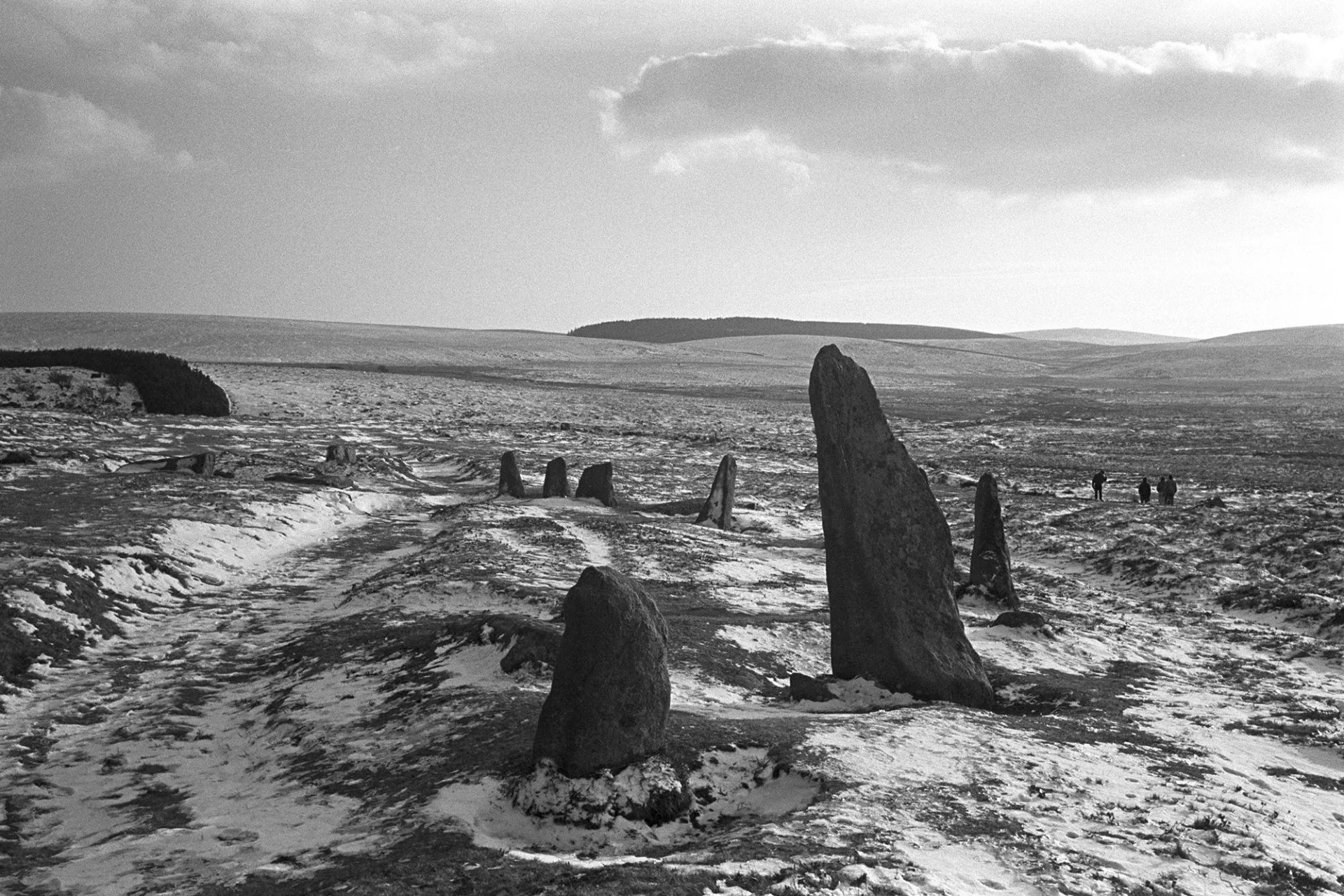
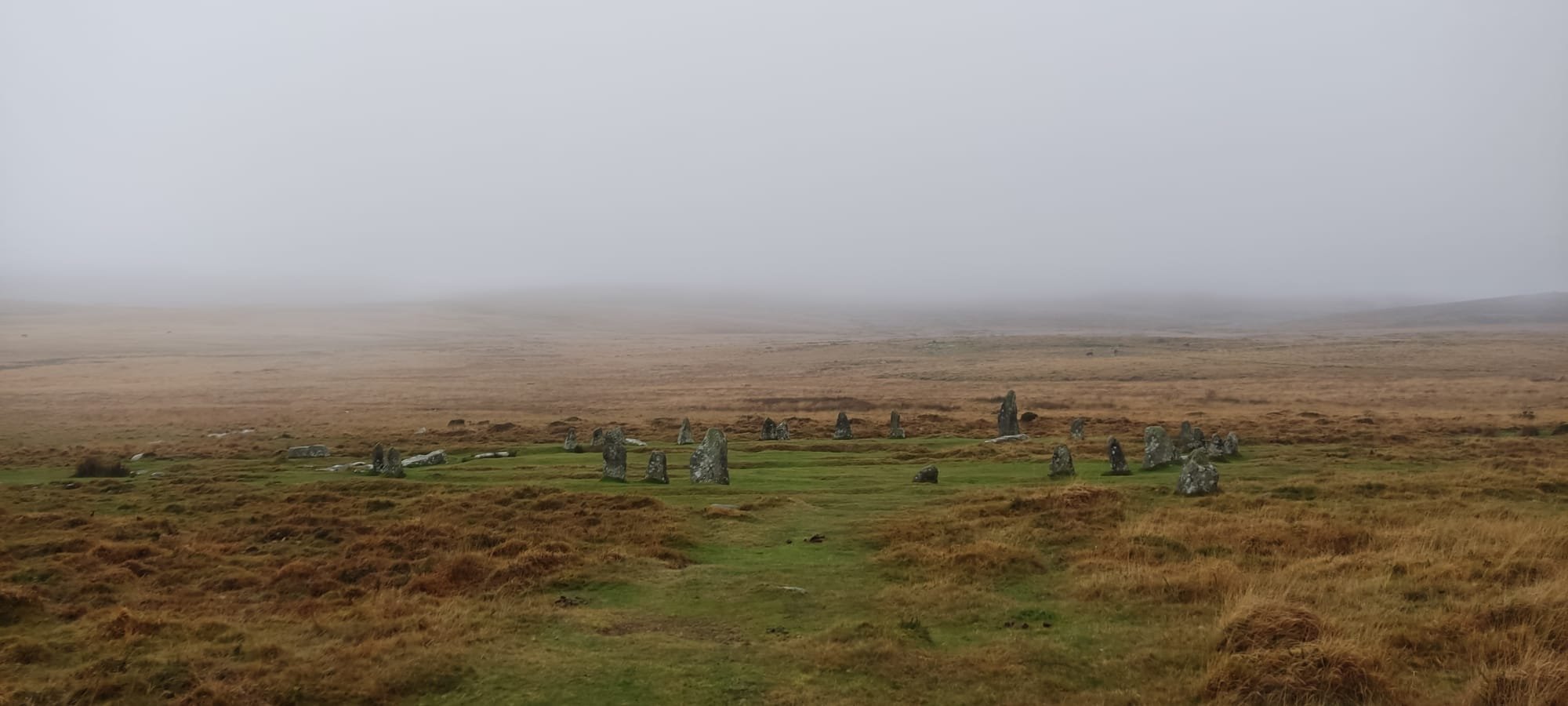
Standing stones. Photograph by James Ravilious © Beaford Arts digitally scanned from a Beaford Archive negative.
Documentary photograph by James Ravilious for the Beaford Archive © Beaford Arts.
Oft I had alone at every dawn
My sorrows to lament – none living now is there
To whom my heart I dare
Openly declare.
- The Wanderer
Goat skin, carved, cured and stretched
into a heartbeat – that was the first
fell hammer against the buzzard’s ear
when it guzzled spleen and watched
the arrival of man. It tattooed again
into the setting sun and once more
into the morning until the buzzard
could no longer distinguish between
the footsteps or thuds of brick and grave
and bowl and the bird was shot and skewered
and its tiny porcelain skull rolled over the strawed
floor in the playful palms of a child;
that was when they knew
this was Toppa’s village. Strange sounds,
strange birds and colours and soon the stink
of blood and wine and the buzzards saw
great wooden plumage cutting the
ocean’s jaw and men cowering in
their timber avian bellies. Soot and smoke
calcified into whitewashed catacombs
spilling in avenues and dribbling down
the paved quay and the buzzards nicked
their nicotine-beaks and wondered why
the woman had come to Topsham. Swept up
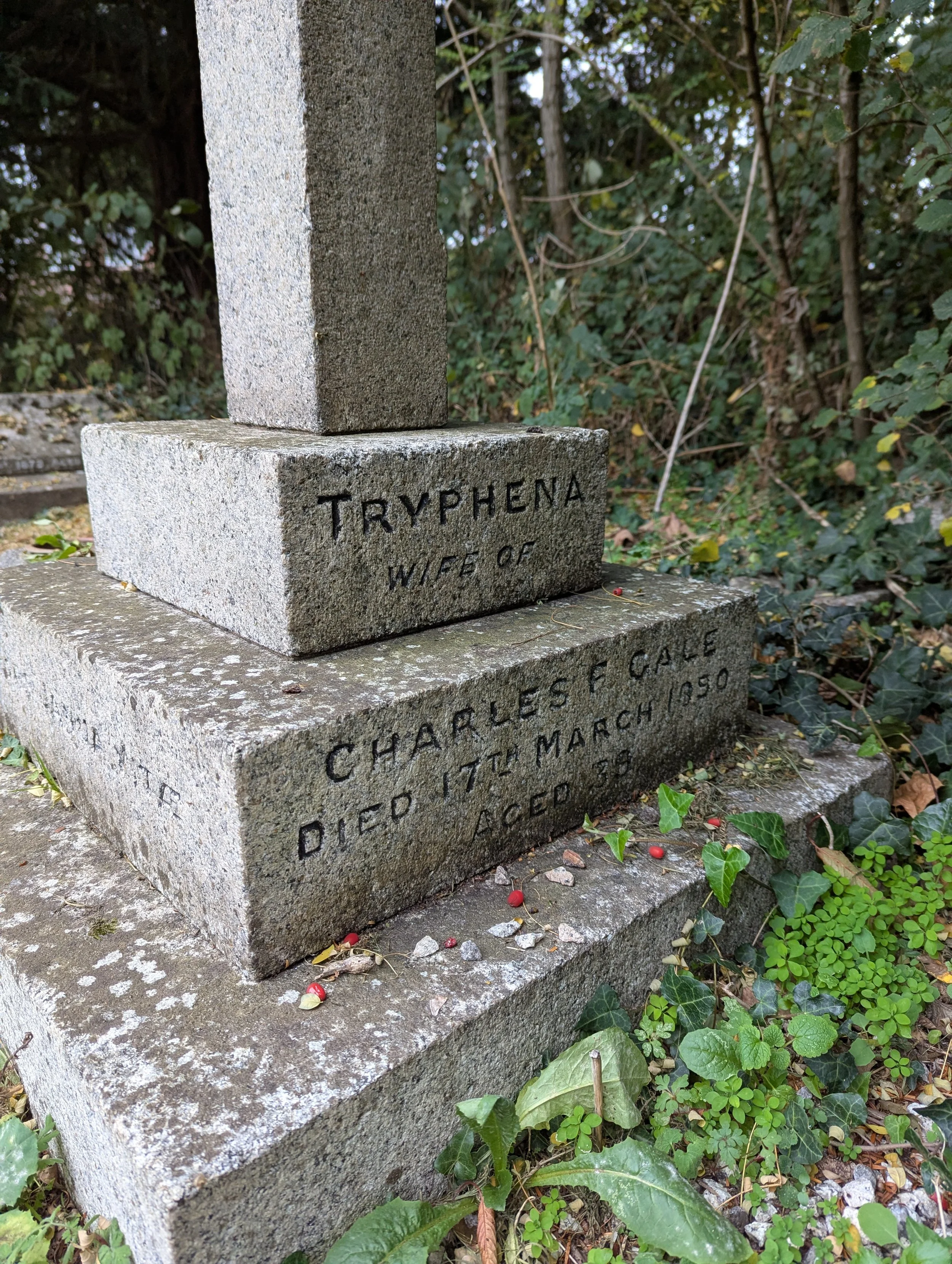
by a Gale, Tryphena abandoned adolescence,
torched the leazes, and picked Toppa’s pasture
to bury Hardy’s ring and grow the gold
to flower. Buzzards and fishermen
and deserving mouths ate sweetbread
from her fist and lapped the kindness which
spills from heart-cracks and the birds held
assembly with their corvid cousins and
made covenant to never strike the neck
of a worm which reared from Tryphena’s
grave. Hardy blew in with the snow; dark
and occupied – the buzzard resumed
its lapine dissections and did not heed
the hurried note sacrificed on the cross
in memory of a muse or a lover
but when those ink-stained atriums and ventricles
clutched and thundered from his chest
this hunched killer balled its wings
and pelted for the mantle – terrified
that in that empty churchyard
it had once more heard
the sound of drums.
Documentary photograph by Roger Deakins for the Beaford Archive © Beaford Arts.
Graveyard. Photograph by James Ravilious © Beaford Arts digitally scanned from a Beaford Archive negative.
“Once thou hast heard on hillside’s slope
The melancholy cuckoo calling in the wood.
Thereafter, do not thou be stayed from journeying,
Hindered in thy going, by any living man.
Seek the deep…”
- The Husband’s Message
If the sea is the primal mouth;
yawning desire and chewing mountains
into glass – then the moor
is the creature’s stomach: vast
and swelling and folding over
and over and over.
This hare’s belly is quietly alive –
it lingers and slopes with the weight
of gorsy bacteria; the stones have roots,
the moss has eyes, the dirt deals in
memories. Here is directed,
in gastral omniscience, the nightmares
and evil and sin. Here, shadows flock
to die; burnt up every morning
in clots of crimson and blue. Empty,
yet teeming –
the transmuting of death into life
is one more instance of digestion
in a divine system intent on boiling
demons into dragons – freedom offered
for the price of wings.
You taste it
in the tendons of the tensing soil
and the contractions of a broken birch.
If you are alone and stewing
in that balmy, draggled light –
beware –
you are already swallowed
and to resist
is never worth the fight.
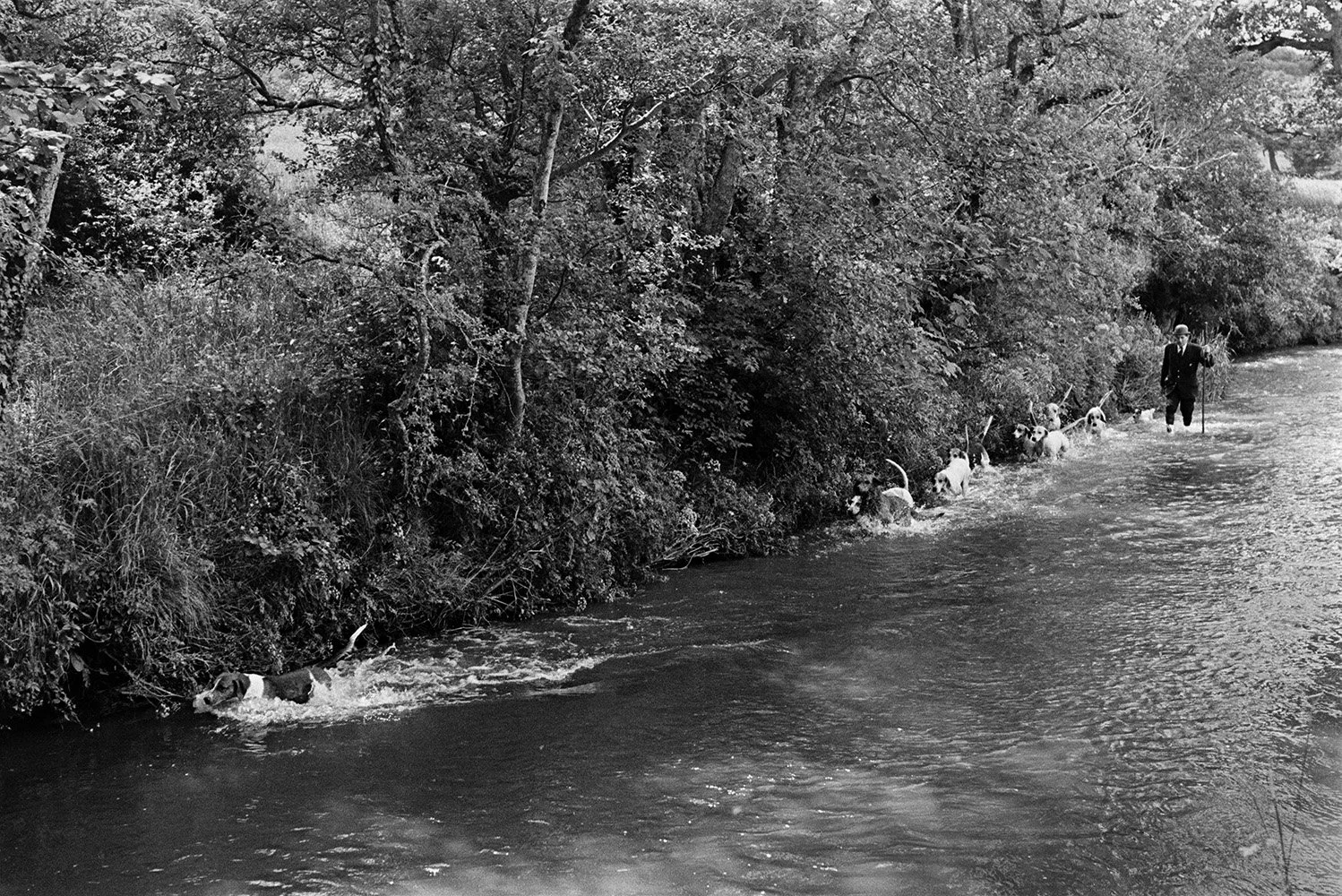
Hark the clamour of hounds and horns
jettisoned by spit-flecked spectral
lips – billowing bloody murder
on Devon’s moors; all creatures
no matter their ilk or size tremble
when the hooves of the Wild Hunt rip
and wreck the bracken – the only creatures
whoever dared to snarl and snap
the heels of the hares in their orbit.
Old Crockhern himself, knock-kneed
with the weight of Wistwood witchcraft
could not placate Cabell’s hounds –
those bawling shrieking blemishes,
who’d fang the Devil’s honeyed fingers
and gore the Sun for the taste
of a single cosmic tear.
That was what brought the physician –
those rattling gut wails forcing boulders
to shake beneath their moss –
yet still, Doyle came,
dressed and pomped
and stinking like London;
he slumped into Fox Tor Mire
and pressed a stethoscope to the peat
and listened to its rotting heartbeat.
He knew that no incantation would quell
what the Devil himself could not restrain
and sought instead a different spell
and found salvation in the human brain –
Holmes! The sound alone breaks fantasy
and makes circles of poor paradox;
those baying shades with burning jowls
could not out-talk that lucid fox
and fled debate and reason both and
stopped and stalled in sin and growth;
no longer do they bite or prowl
yet, if you tarry and cock an ear
you might just catch their final howl.
Perhaps you’ll hear the hum-hiss
of armoured bees, drudging honey
and droning poison in Plath’s ear –
bumping fuzzy lances against
the bell jar with all the rhythm
of a Roman mob; the moor was not fond
of Americans, but made exceptions
for a pithy tongue whip-cracking fascists
and digging small heels in the sides of lions –
that magician’s ally,
that woman from the foam –
resurrected at dawn
to char the distant tors
and bring them into clarity.
Lent lilies prostrated
and clamped green hands to gilt mouths
afraid those spun-sugar fingers
would twist their trumpets
and croon chaos in the cavity;
this moor could not decipher why
it sensed her glass-wrapped steps
like ruddy thunder on a wire
and why – once those footfalls
ceased, the sound was louder still –
never before or since could that giggling,
riotous mass of land remember
a louder silence.
Egg,
then gunk
then foot – branched
and burst from calcium –
that trident noose clawing
for oxygen, that pink afterbirth
beating naked wings;
there and forever
was Crow. Cawing forth
the pinion stubble – that black
rainbow, those quills of kings
dragging, dipping, devouring;
it roamed and sought the
earth quivers, where coiling worm
counted loam and bang! Stilettoed,
dissected, ripped into Exodus –
Crow cut patches of that coral flesh
and gobbled and feasted and
paused – knowing once more
it was under the eye of another –
the man was following Crow again.
Beatle-browed and pinching verse,
crouched and quiet and watching –
always watching –
thumbs orbiting the blackened nib
to paint nature’s calamities;
Crow resolved to return the favour
and skated clouds and half-heartedly
sniped the squealing wisps, never removing
its onyx glims from the man’s long coat –
he often strayed and bent to stroke
the floral cilia, but would start and flip his shoulder
and steel his eyes
and hawk Crow with hanging glares
and force the bird to descend and strut
like a puppet on a string –
jerking the motions
in primitive mummery –
and he would laugh and laugh
and laugh again and walk away
and that troubled avian would
skew its face and puzzle
why he was never shocked
by the interests of a puny god.
The man left and returned,
grizzled and palled and scooping
dirt with crocodile hands
and Crow approached once more
and saw him digging in cow bellies
and hooded, fleeing the rain cuffs,
chasing bleats and fearing horses.
One day, when Crow could feel
the gum in its eye and the slack
in its plumes, it circled and dropped
and that raking foot once more mauled
the air and Crow knew it was dying
and when a vast shadow split the sun,
the bird raised its gaze to spit in the Devil’s eye
but instead once more met the man
stooped and studying;
am I dead? Asked Crow
no – said the man – and Crow believed him
and died and Hughes gathered that soot bundle
and buried it in a cairn by the river Teign
and never laughed
at another bird again.
It is difficult to find circles
In a jagged land – but carve the rowan
and drink the rings and know
the hares are happiest darting
over marram grass on tufted wings –
those crystal strands, pale and pure,
a white-gold crown
upon the moor.
The valley of the River Torridge looking south-west towards Dartmoor. Photograph by James Ravilious © Beaford Arts digitally scanned from a Beaford Archive negative.
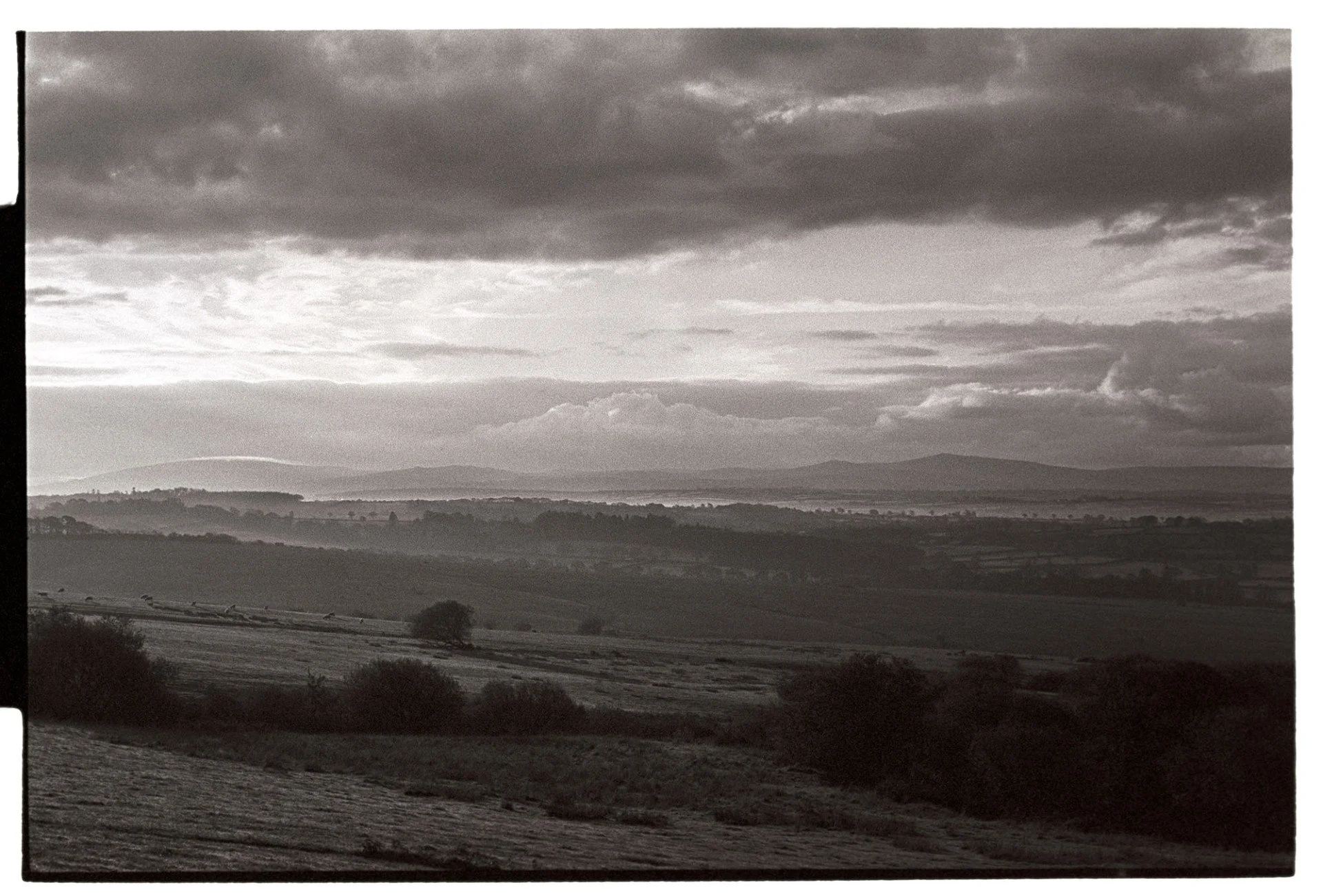
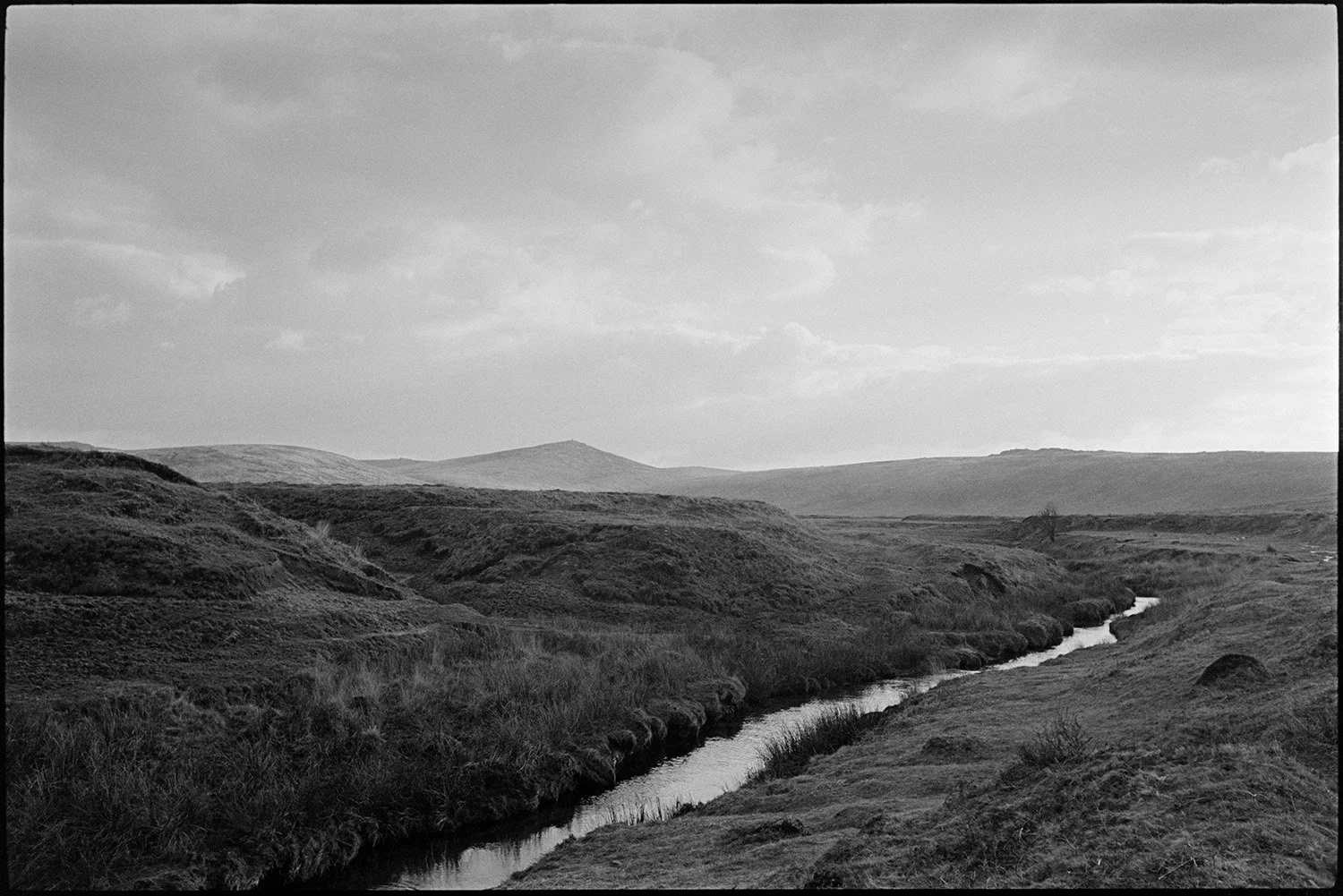
View across moor to Dartmoor. Photograph by James Ravilious © Beaford Arts digitally scanned from a Beaford Archive negative.
Documentary photograph by James Ravilious for the Beaford Archive © Beaford Arts.
“Though sad at heart
Across the watery way a weary while must he
Stir with his hands the rime-cold sea,
Tread exile tracks: full pitiless is fate!”
- The Wanderer
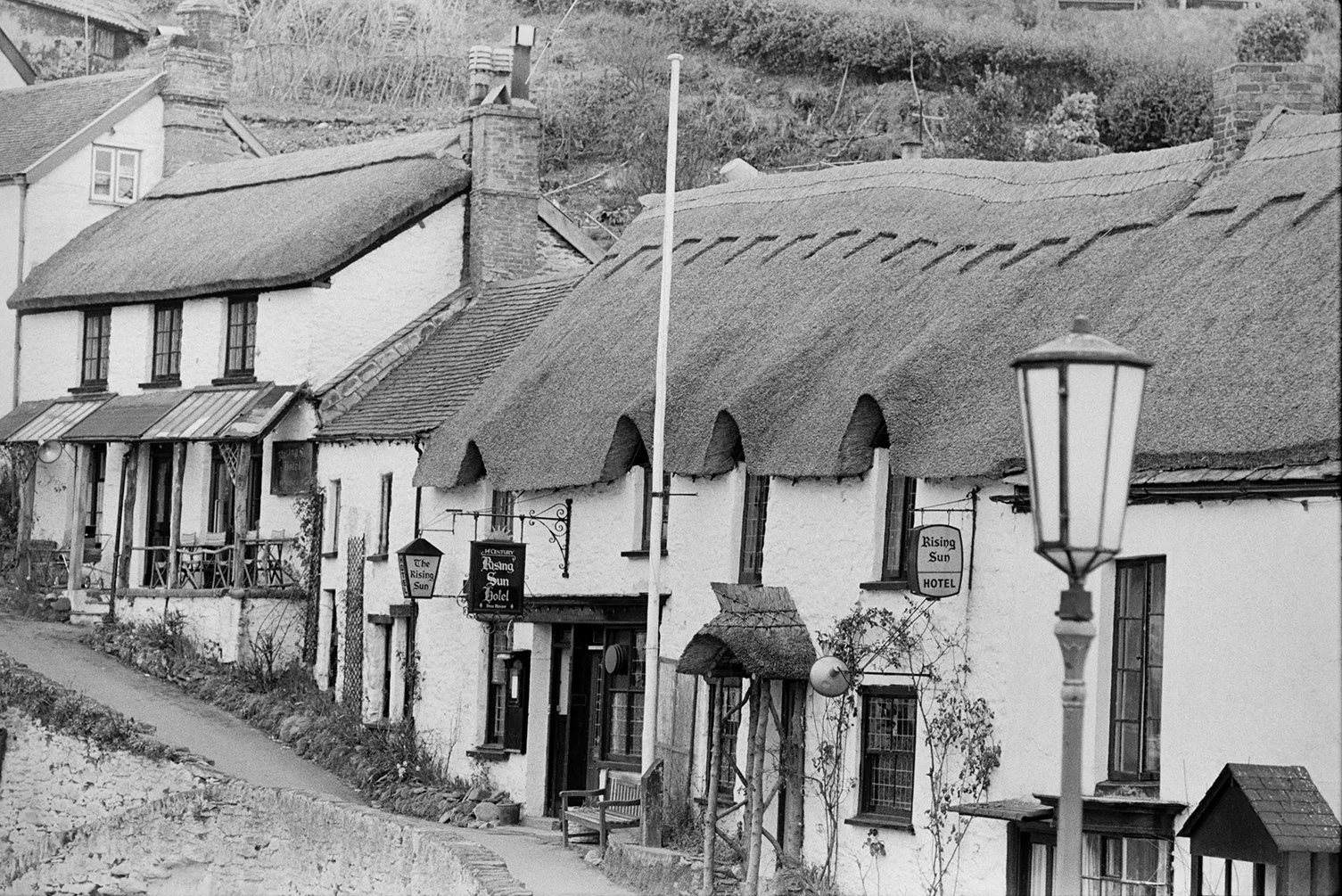
They were there to witness the timber lumps
heaped and squabbled into a burh –
and later saw the flash of shears and
traded riches bleed and blur;
from this peopled paean, rose a town
of rosy brick – the inner tower rising
higher and higher –
a perpetually leering,
four-faced-liar.
Unnoticed and forgotten, hiding
amidst the bony bric-a-brac
in their holts and hollows – they did
not expect the man to follow their
brown, bouncing thread –
shellshocked, gassed and disillusioned,
Williamson ceased to understand man
and his works and instead turned to them;
those needle-teethed denizens
of the watered world – slick
and bloody-whiskered wanderers,
whacking their club tails with all the gusto
of Jupiter’s thunder – they were honest,
more so, perhaps, than the world
he had left behind – they did not trick
or faun or placate their prey but sought
and pursued and pincered and
did not waver a single obsidian eye
from the Salmon’s lidded peeping,
but ripped and tore and feasted
and made crop circles out of the bone.
He trailed after their sodden paws
and parted reeds and crouched below
their clapper bridges, sharing
their apprehension of hunting hounds
and baying horns, watching
from afar this people’s strange ruck and reason –
witnessing once, the passing of a mother’s kitten,
knowing that he himself could not condemn
when more than any ideal or whim
he would rather flee his checkered reality
and become one of them.
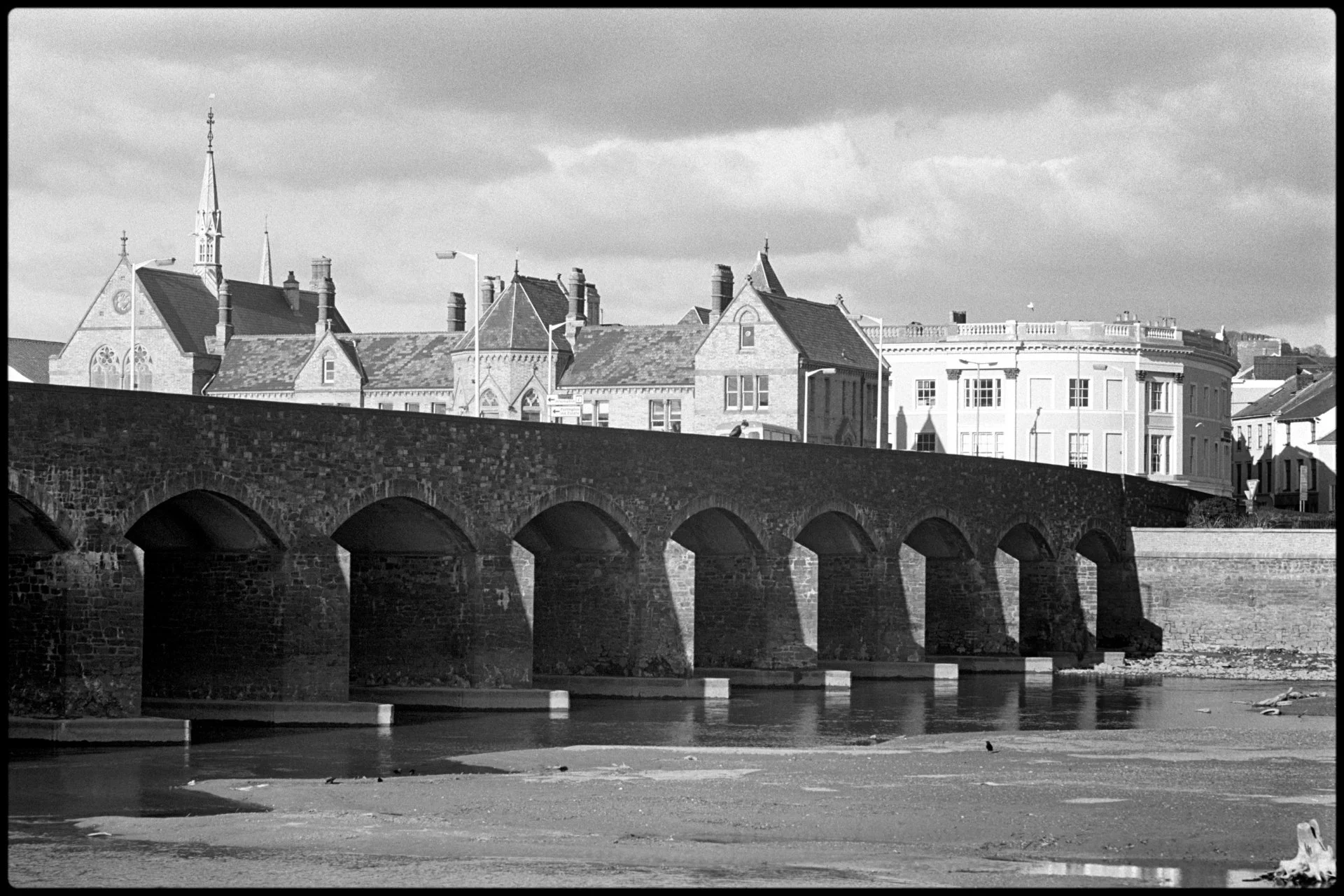
Barnstaple Bridge. Photograph by James Ravilious © Beaford Arts digitally scanned from a Beaford Archive negative.
Documentary photograph by James Ravilious for the Beaford Archive © Beaford Arts.
Documentary photograph by Roger Deakins for the Beaford Archive © Beaford Arts.
“Little did I know
that ever before or after,
I – mouth-less – across the mead-bench would have to speak.”
- Riddle 60
Stabbed and whipped and trailed
up to Golgotha – the little bird
watched with cryptochrome beads –
and came and nestled inside Man’s cavity
and leant its beak inside His heart
and flew away, scorched and smeared,
with a newly garneted breast. Now
the ruddock stalks the gardener’s boot
and hunter’s noose, to snipe
and gobble whatever rears
from the soil’s afterbirth; worms
and beetles and lizards and, if a chill
caulks shut those loamy lips,
then it will stiletto flesh gobbets
like its ruder brethren and angle
by a crystal pool, cutting up
its own kitsch reflection –
anti-narcissus, self-mocking felon –
the robin came to nest on Devon’s gum,
and watched this toothless mouth
gape and murmur and hum;
beat after beat, tale after tale –
those jaws motioned and the hares
trampled heaven and earth
to try and keep up
to no avail.
They did not bolt fast enough
to catch sight of Austen’s beau
and had to consult the robin
for garbled scraps of heartbreak –
served in rain-spattered evenings
and the fresh clutch of tears
at the clergyman’s wake.
Snooping the tearoom for crumbs,
the ruddock witnessed the fast fingers
of gentle Jane stretch and dart and clasp
another – and later pecked snags and snippets
of the wit and irony reserved for a lover –
it is known that that indomitable hand
penning prose and parody, stilled
for many months upon receipt of a letter –
yet the hares never knew
if it was a gospel legend
to entertain in good humour
or merely another
chattered rumour.
The man who invented tomorrow
often climbed Jacob’s ladder
to better watch the honeycomb puddles
where – beneath the beadlets, snakelocks,
shannies, blennies and crabs – he would scry
the probing glint of an otherworldly eye.
Wells alone, thrust a palm into the sea shafts
to wrap his wrist with suckered wires
and drag his homely krakens
into the common man’s mind
and memory, to better bind
and seal that ancient nightmare
with a cheerless ink
of blood and emery.
The robin liked the rutted verse
which clicked and cascaded from his lips –
this tweed-and-tie magus,
mouthing consonants and inventing heritage;
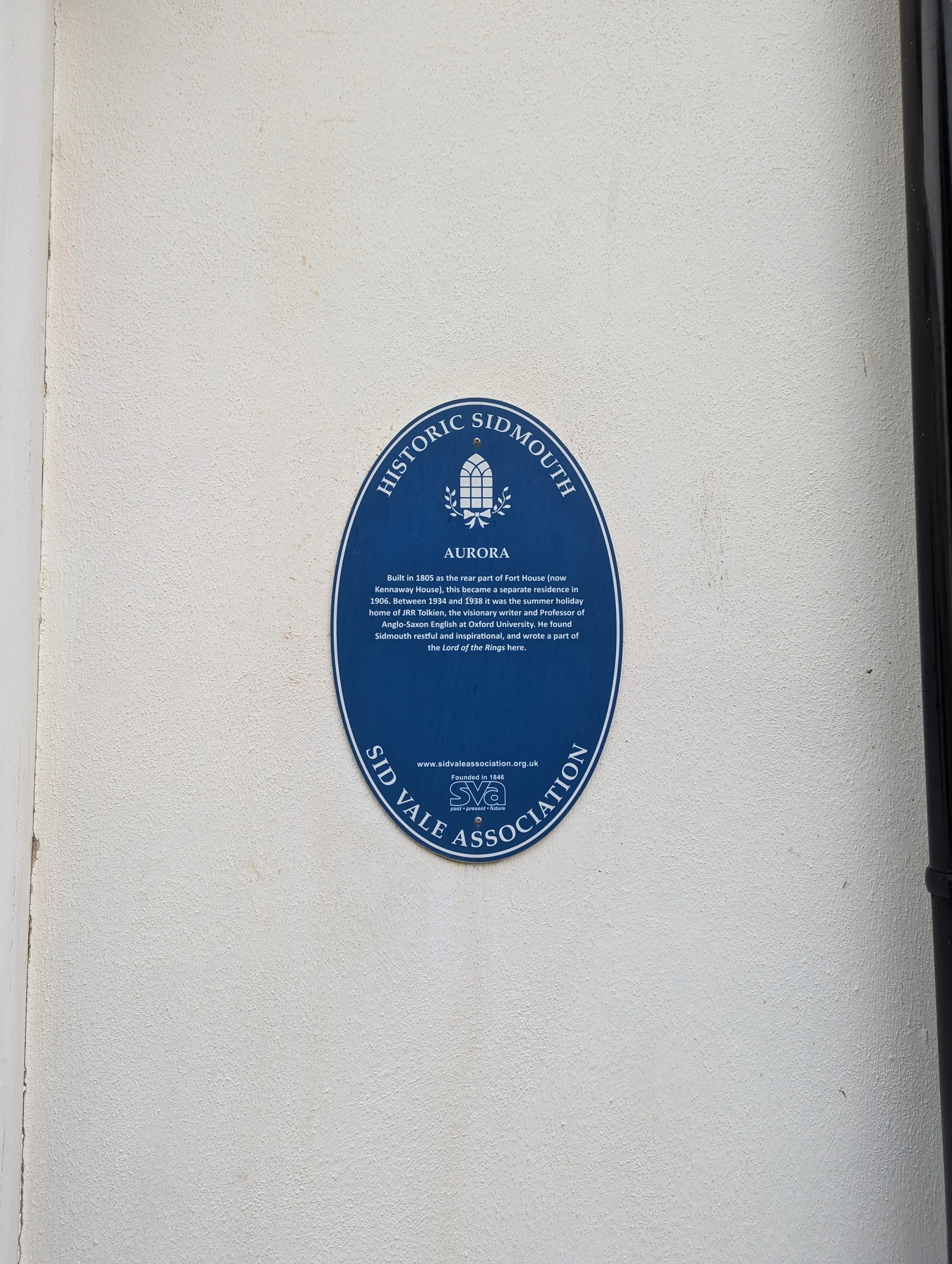
Tolkien cosied himself in Kennaway
and forged his fable out of patchwork sagas
and regaled the bird which nestled on his ledge
with a syllable bouquet –
often he would eye nearby patrons
through the smoke and haze
for a thought or a phrase
to polish his kenning clay –
he looted Plato for his ring
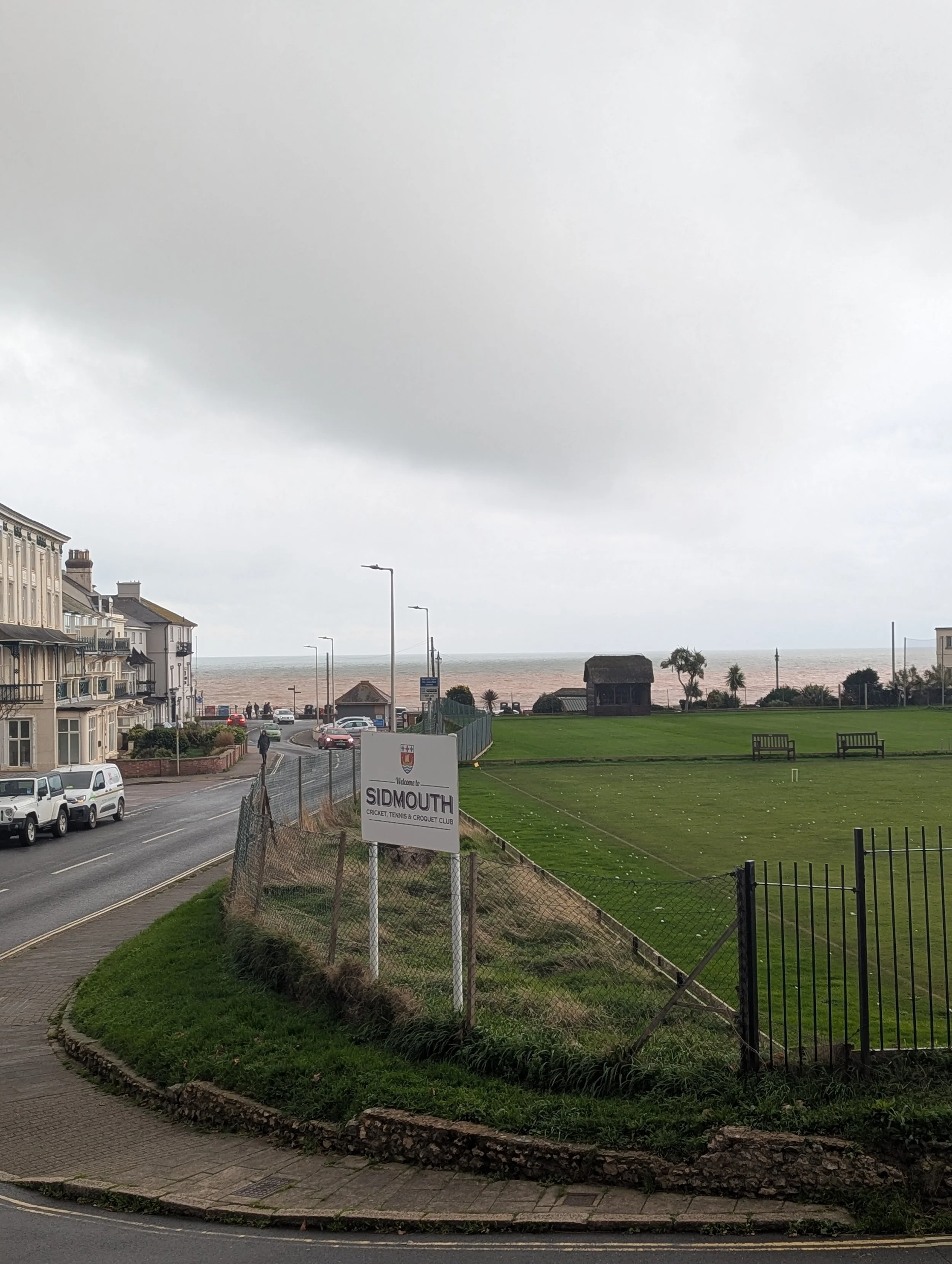
yet hawked the sights of Sidmouth
for the pattern of his king.
The hares clucked and purred
and begged the robin for more –
the story of a riding horseman
or a Stymouth to explore –
but the ruddock fled at break of day
chirring and chuckling –
at the gall of its play.
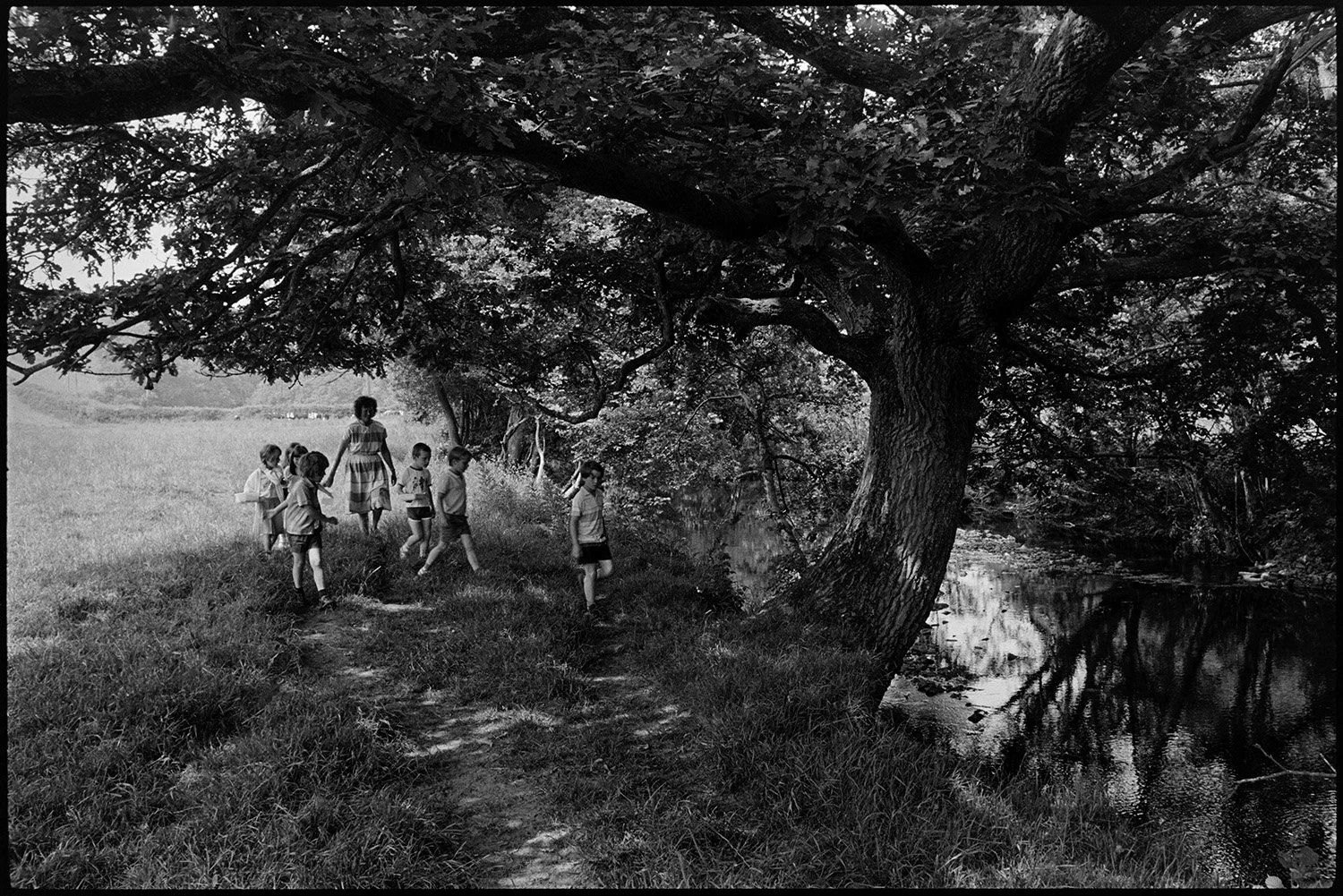
Farmhouse window ledge. Photograph by James Ravilious © Beaford Arts digitally scanned from a Beaford Archive negative.
Documentary photograph by James Ravilious for the Beaford Archive © Beaford Arts.
“Ancient work devised with skill
….. bent under crusts of mud.
A mind grew keen, swift purpose drew,
resolute in rings…”
- The Ruin
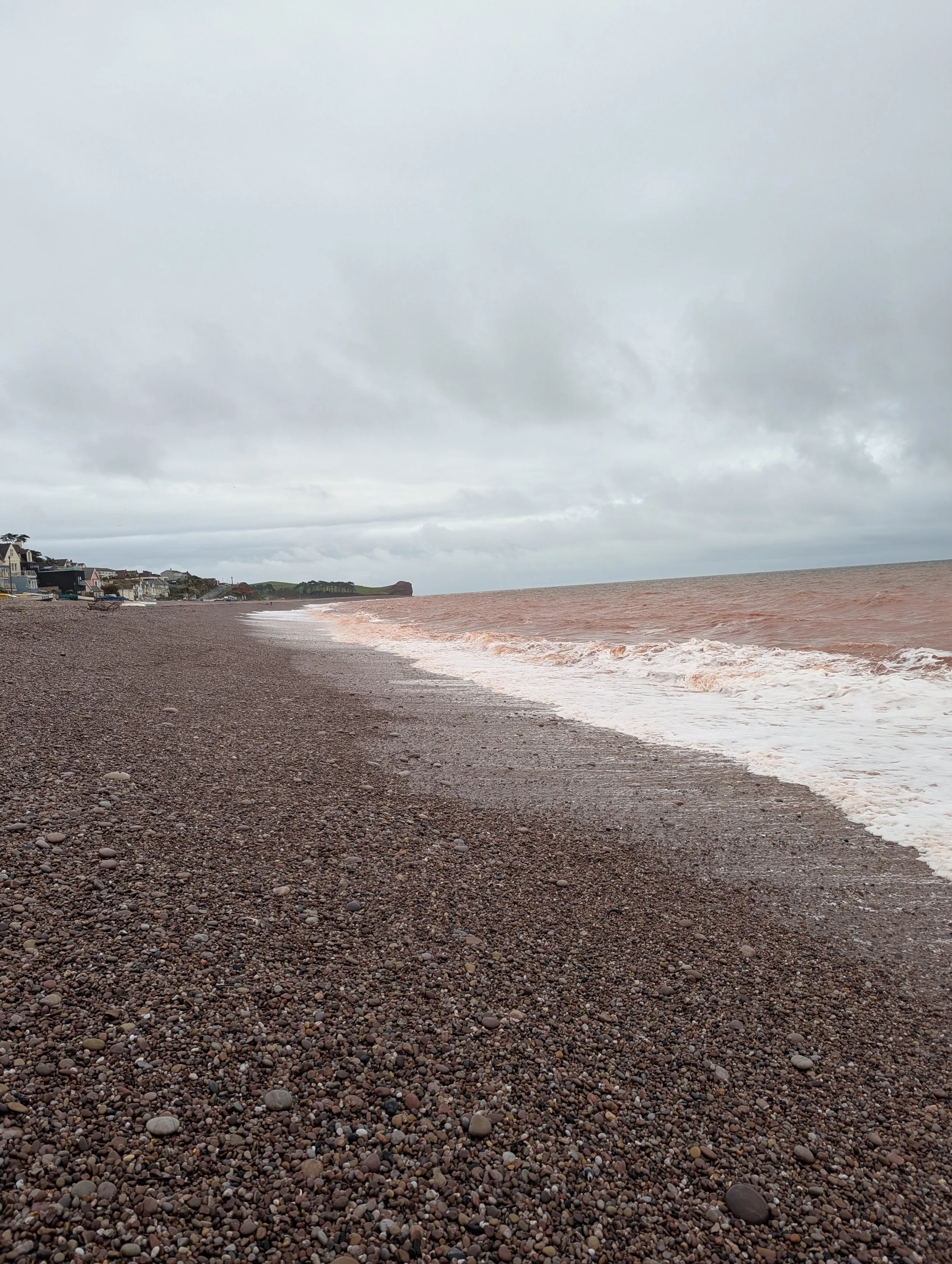
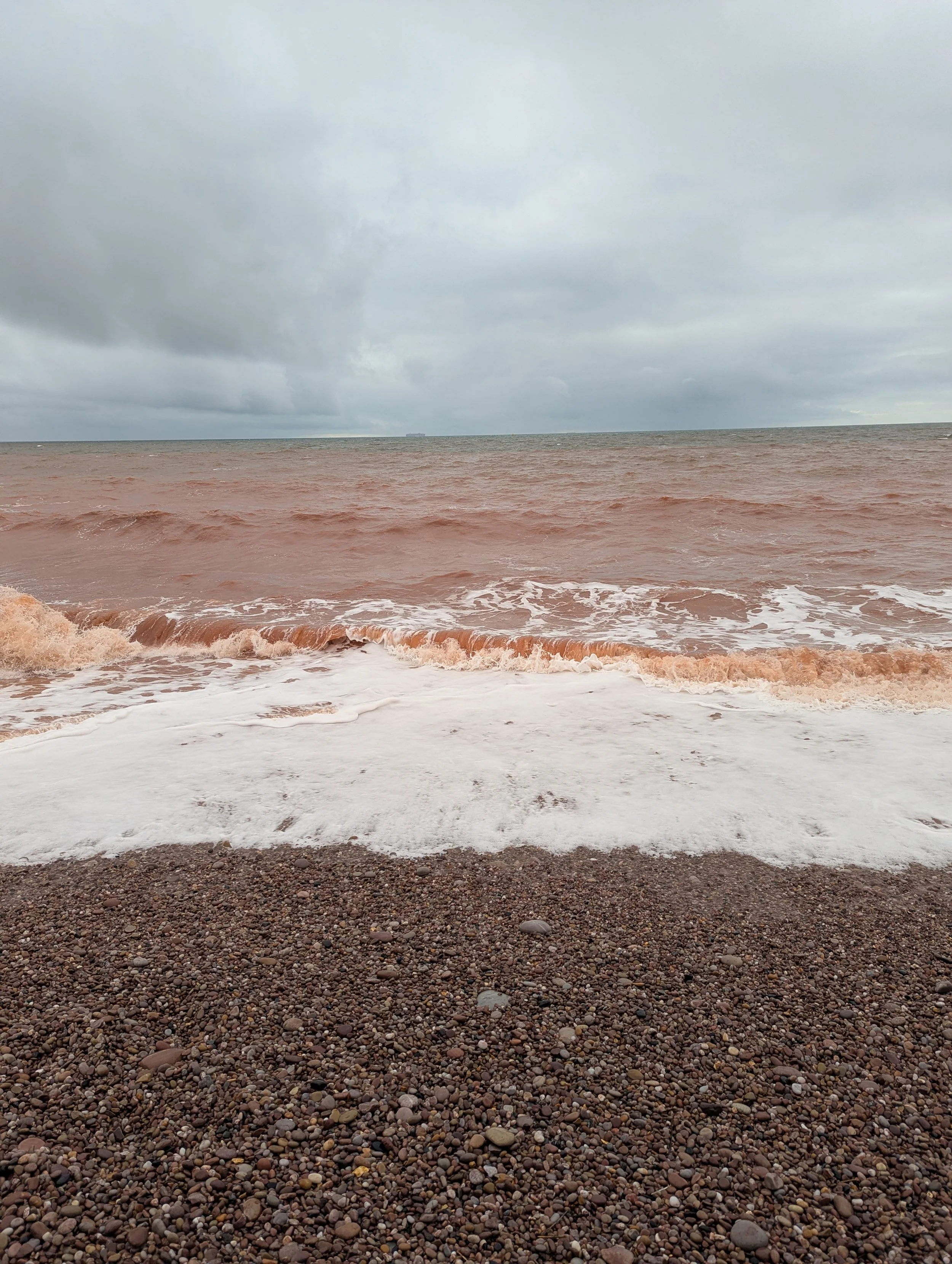
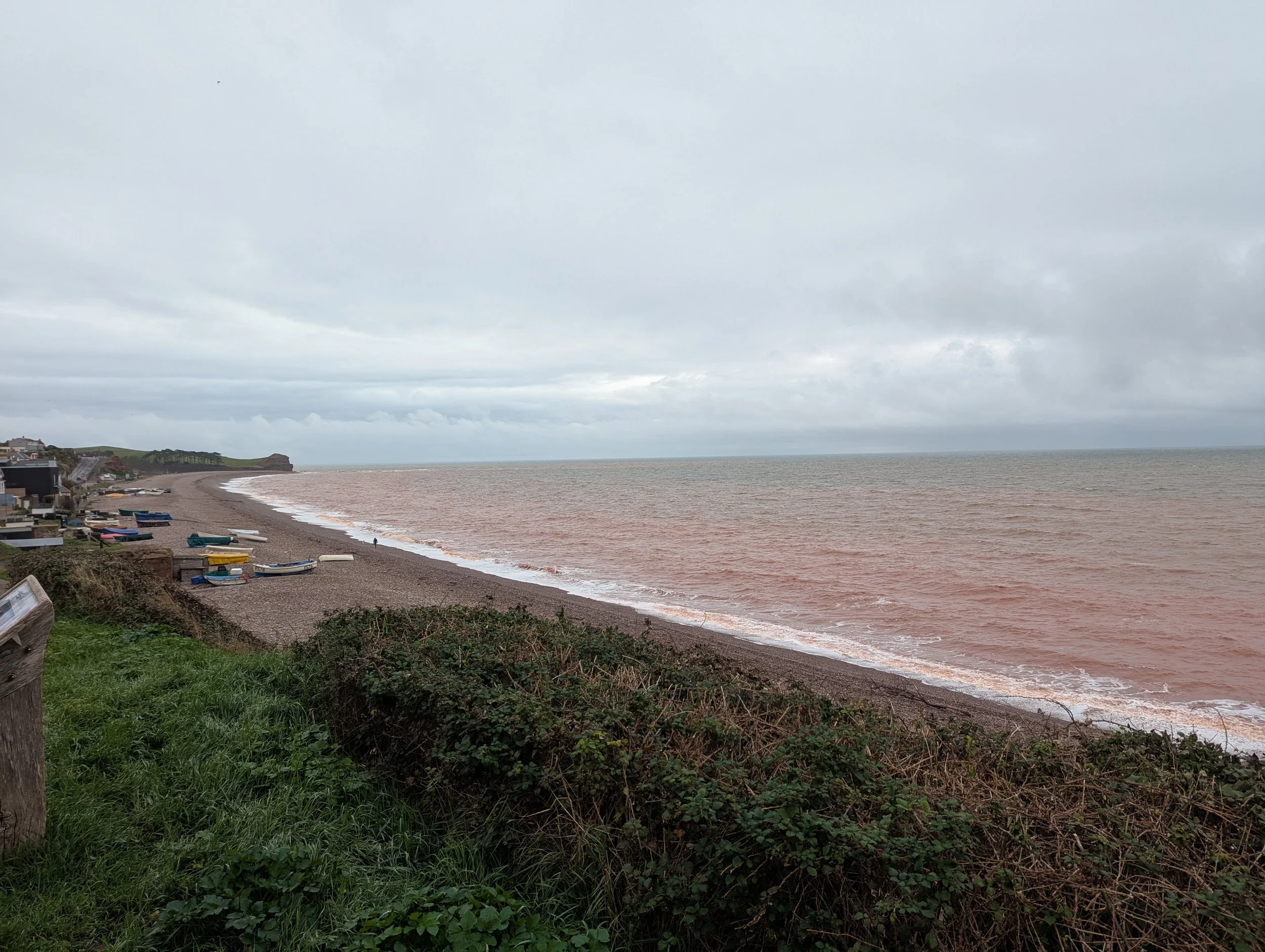
There is blood in the sea.
It muddles and oscillates
in an oblong haze, pulling the russet silt
which seeps from a soul riddled by revolution;
an infant Mantel, milk-haired and indignant,
poised upon the bluffs and glimpsed a ghost
of greater safety – seeding future visions
of a pebbled paradise. She left and learnt
to seek delineations in the tempest
of a scribbled sea and sky – that crooked mirror;
that primal light – and tasted dust of dust
upon her tongue. Exhaustive, extracting
every detail – those finite gasps – clasping
a dead man’s soul between needle, nail
and thumb like a sick oracle
gluing antiquity’s debris.
Enriched at last
through that Anglican appetite for roses
and wolves, she returned to Salterne
and teased her steps across
those shingled shores – each pebble squirming
under the heel of a mind which holds
the crystal truth: history is squalid
and trumped and mean
and honesty in the annals is a gift
won through wars of dirty hands
ransacking time
to puppet rotting corpse fingers
and pitch pretty shadows on the wall.
Now the sea looms impoverished
and the gulls wheedle their dirge,
mocking mourning for such a treasured wit –
that fluent pithy cup; a lip and a pen
which demanded the departed
shake their rust,
collect their spittle,
and now and forever
get up.
Documentary photograph by James Ravilious for the Beaford Archive © Beaford Arts.
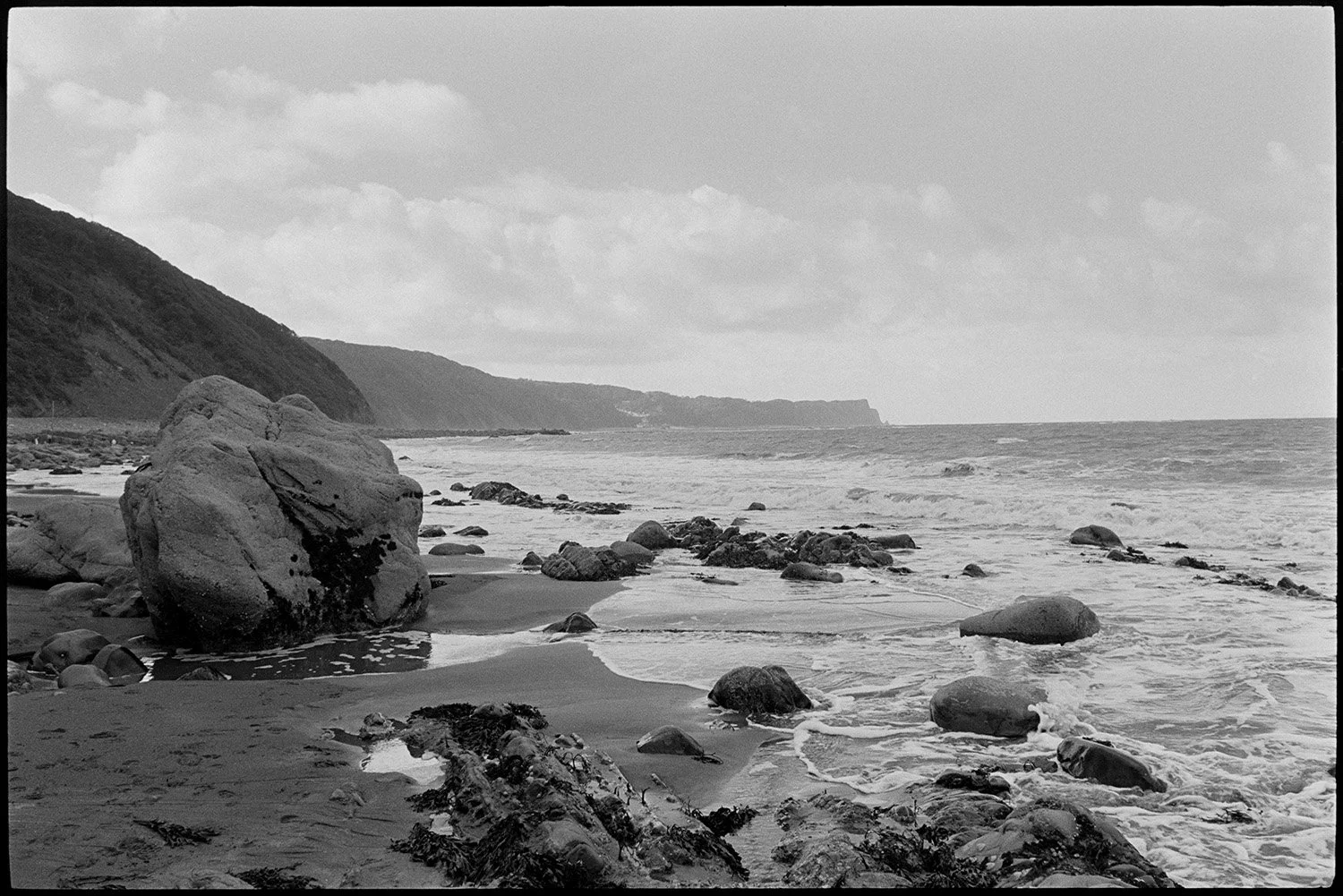
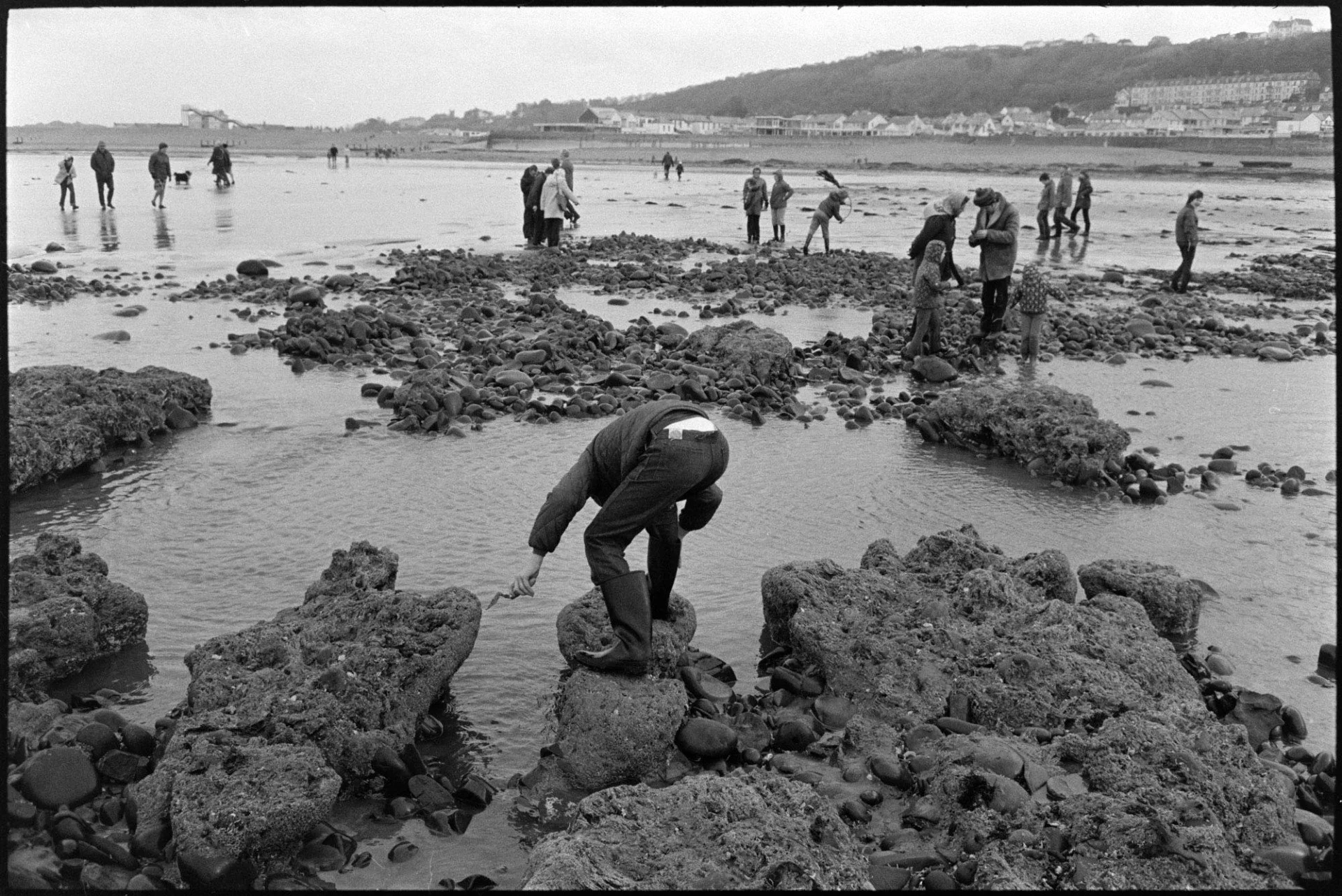
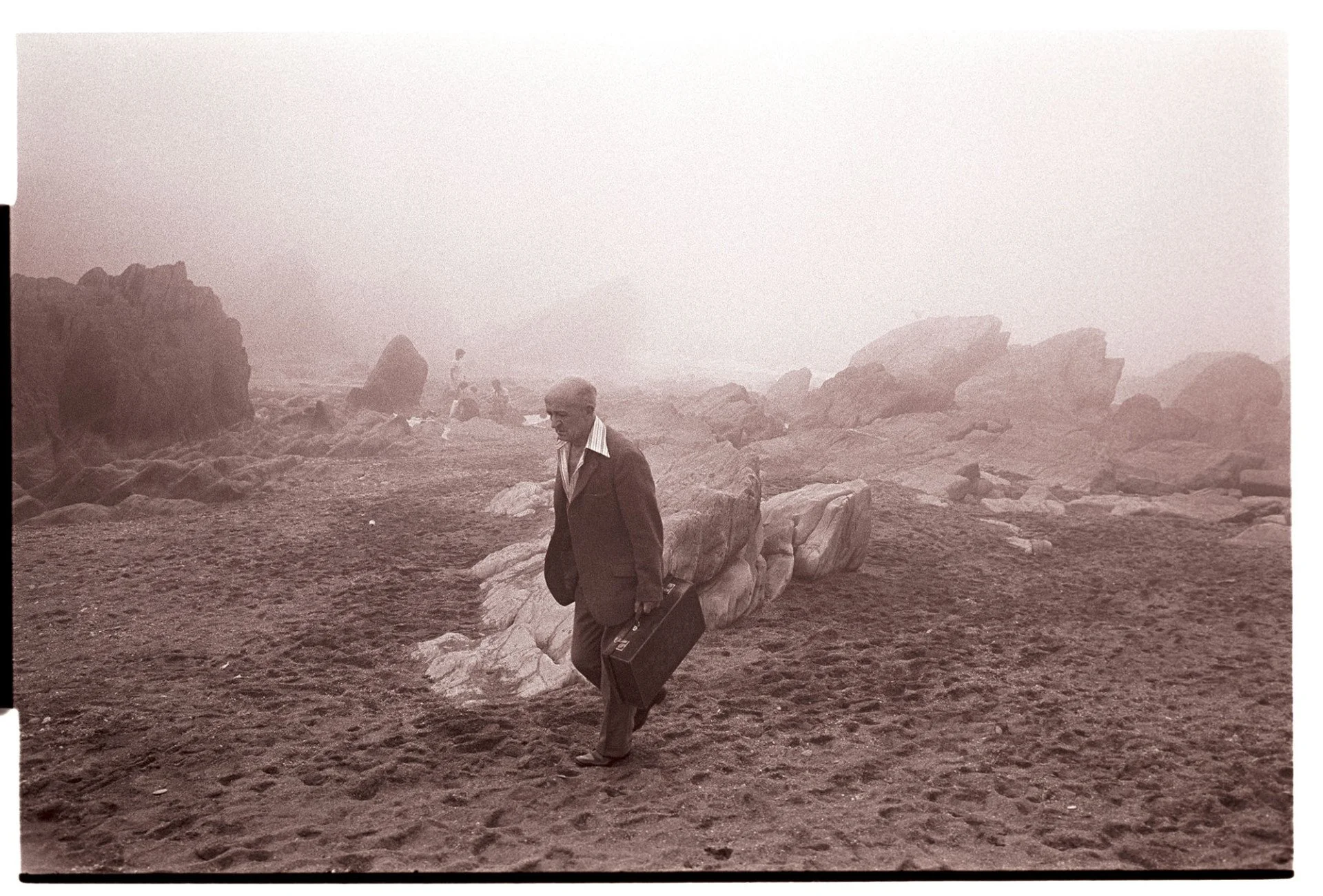
Holidaymakers on a rocky shore in thick sea mist. Photograph by James Ravilious © Beaford Arts digitally scanned from a Beaford Archive negative.
Documentary photograph by James Ravilious for the Beaford Archive © Beaford Arts.
“I little thought
That I should ever, at any time,
Over the head, speak, mouthless,
Swap speech.”
- The Husband’s Message
Winding, spitting, medley
of voices crying, gossiping,
murmuring, spitting, singing,
running on and on and on –
this is the anthem of the river,
and she does not crouch at its bank
recording flora and fauna with Darwin’s eye.
Oswald leaps
and splashes deep
into the fray itself – feeling the chill
kiss her palms, tasting the clarity –
rolling it like a sommelier
on her darting, gardener’s tongue –
somewhere, somehow amidst
the wordy bedlam,
you become I,
and that is perhaps
the greatest gift of poetry;
that in the rush and torrent
of a Devon current, I can listen
to the song of myself and know
the efforts of a talented bard
can one day become my own – I who
have also walked those sculptured banks
and shared bread and laughter with friends
and almost slipped on that pebbled bed
when crossing the northern leat –
drawing the weight and wisdom
of heritage waters, those droplets
solid and sweet;
there is muscle in a symphony
which can break and heal,
there is revelation in understanding
I am just another note –
one more ringing spoke –
in Devon’s storied wheel.
Documentary photograph by James Ravilious for the Beaford Archive © Beaford Arts.
Can you hear it –
were you listening?
The circle; the circles; the circling;
every knocker, every piskie, every birch
and raven and jackdaw and dunnock
and droplet and flower and root
and lark and bluebell and feather
and flea – the chanting salmon,
the whistling sea – the blowing buzzard
and buzzing bee – the rattle of Crow –
the humming lent lily, perhaps
the harping robin, the tattle of
marram grass, or the river’s
weaving, winding, bubbling story?
None so loud as the belting gorse,
conducting its needles and
ringing bells hoarse –
to repeat its sound,
is to make yourself a limb –
just another verse, another circle,
in this ever-curling three hare hymn;
so roll your breath and mark the curdle,
the cycle has once more begun,
upon this earth –
upon this portion –
they run, they run, they run…
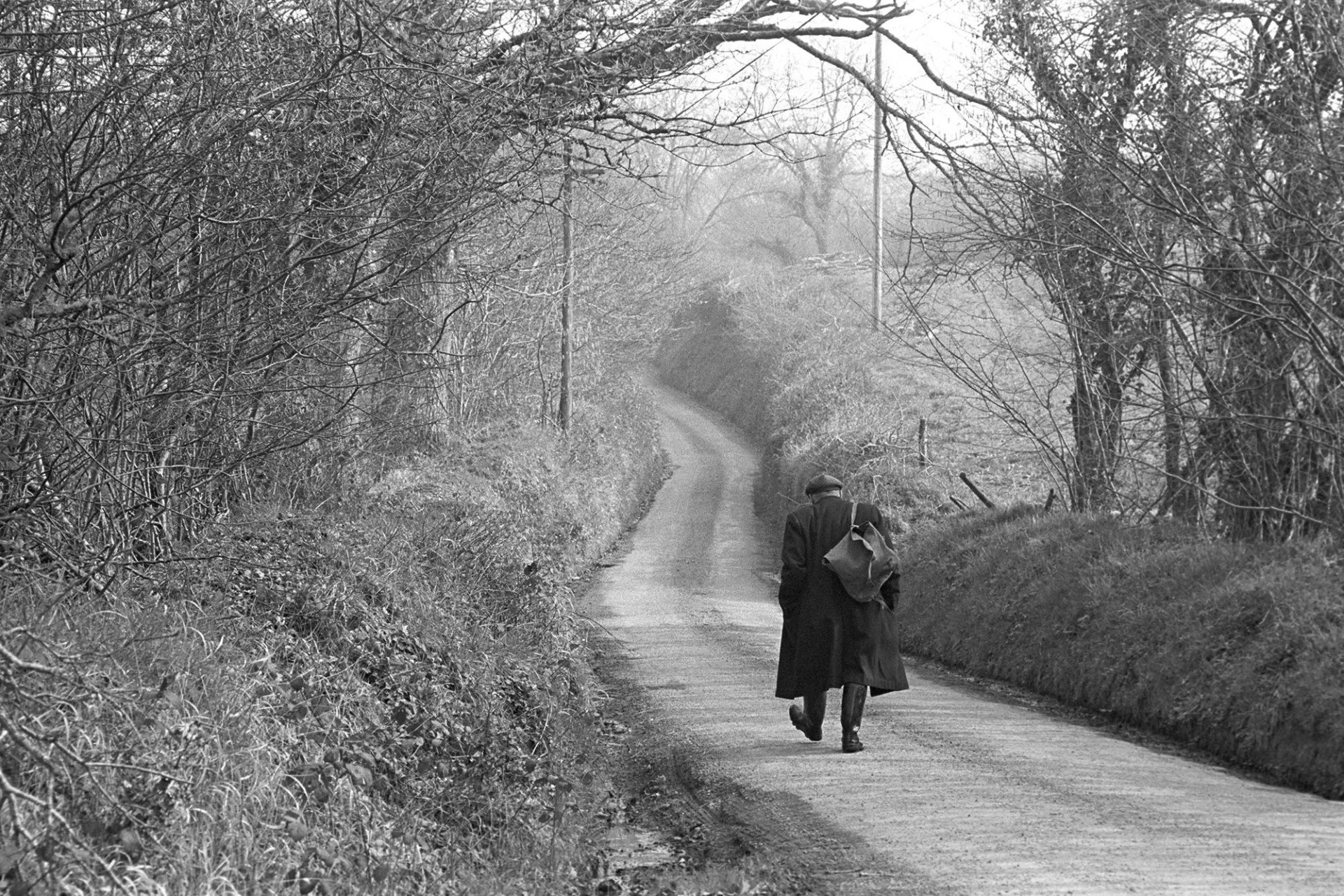
Ivor Brock walking up West Lane. Photograph by James Ravilious © Beaford Arts digitally scanned from a Beaford Archive negative.
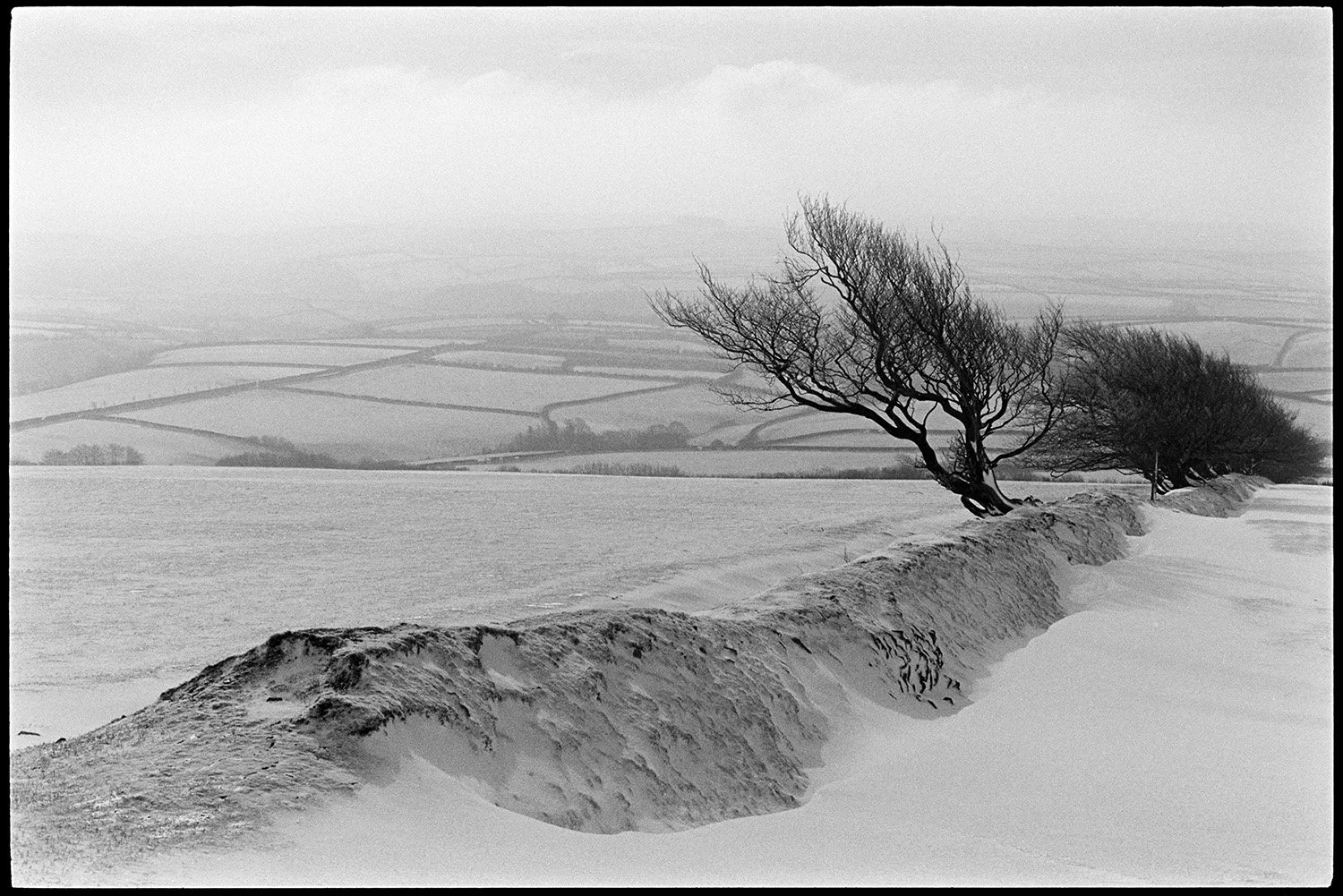
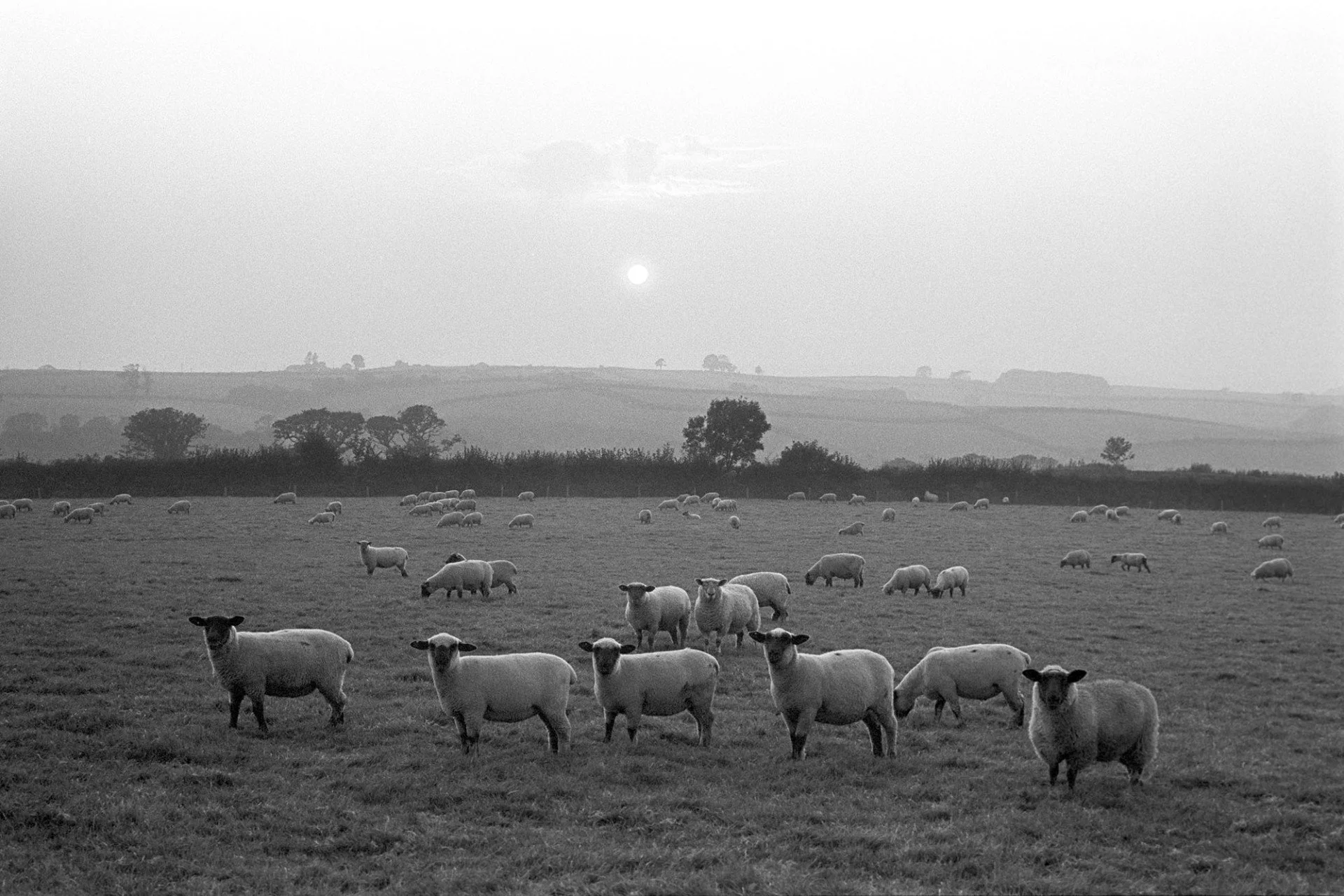
Evening landscape. Photograph by James Ravilious © Beaford Arts digitally scanned from a Beaford Archive negative.